
Do You Believe In Miracles? (Sunday’s Sermon Today- Gospel of Luke)

The Super Bowl was pretty amazing. The Seattle Seahawks and the New England Patriots struggled, banged on each other, and fought for thirty-nine minutes. And then in the final minute, two amazing things happened.

kearse catch

First, Russell Wilson threw the ball thirty yards down the field, and two Patriot corner backs descended on Jermaine Kearse, the fleet footed Seahawks wide receiver. The ball was tipped into the air by Malcolm Butler, an undrafted cornerback who worked at Popeyes and Foot Locker at times when it seemed as if his football career was over. And Kearse touched the ball into the air once, twice, three, four times… and then it came to rest on his body … for a reception. [Patriots fans were reliving the moment when David Tyree pinned a football to his helmet to set up the New York Giants’ winning touchdown in 2007.]

butlermichaelsuperbowlThen, things got really strange. On the half-yard line, the Seahawks decided to throw the ball, even with one of the games pre-eminent running backs on the field. Running a pick play, where one wide receiver legally blocks for another receiver, the Seahawks quarterback snapped the ball and threw with twenty seconds on the clock… into the outstretched arms of the aforementioned Butler. The last addition to the Patriots’ 53-man roster in August, the one who shouldn’t have even been on the field.

Even to someone like me who watches a lot of football (a lot!) these were spectacular plays. They don’t happen every day. They are extraordinary feats of skill, athleticism, and concentration.

To many folks, they had just seen a miracle. Or two of them. A miracle catch, and a miracle interception. A physically impossible play, and a moment drawn up in the sandbox, where the last guy picked makes the biggest play.

But these aren’t miracles. Miracles – in my opinion and in most definitions – actually defies natural and scientific law, involving divine intervention.

A miracle, friends, is the intersection of certain disaster or death with the impossible, hopeful, amazing redemption of that life or moment.

Like our three stories today in Luke 7. Three people meet Jesus and experience an impossible.

In the first meeting, Jesus hears from a centurion, a Roman soldier, an enemy. Remember how Jesus told us to love our enemies and pray for them [last week]? Now, he’s faced with a problem: Jesus is approached by emissaries of the centurion, who wants Jesus to come and heal a servant of his. Jesus goes to see the centurion – and the servant – but on the way, the centurion begs him to stop traveling, as a sign of respect.

We probably think that the centurion is rude: if he cared so much, why wouldn’t he have proceeded to meet Jesus himself? But the centurion’s messengers say, on behalf of the centurion, “‘For I myself am a man under authority, with soldiers under me. I tell this one, ‘Go,’ and he goes; and that one, ‘Come,’ and he comes. I say to my servant, ‘Do this,’ and he does it.'” The centurion believes that Jesus can heal his servant without being there but he also assumes that Jesus is so busy that he wouldn’t actually have the time to come; he believes his needs (or the needs of his servant) are so minimal that it’s not enough to bother Jesus.

Jesus recognizes the centurion’s faith – that he wouldn’t even ask Jesus to be physically present, and just say the word – and says that the centurion’s face exceeds what he’s experienced in people of the Jewish faith. And in that recognition, he heals the centurion’s servant from afar (Luke 7:1-10). In a community where touch caused healing (check out the Old Testament to see over and over how people were either touched by a human being or instructed to be in contact with an inanimate object for healing), Jesus’ healing of the centurion’s servant without even being present was a remarkable moment.

Luke, who we know had a medical background, is quick to point out that the physical elements of Jesus’ ministry lack any kind of scientific explanation. Jesus didn’t even make contact with the man- he couldn’t have deceptively used contact with the man or his surroundings – and the man was healed. But Luke is far from through with his testimony about Jesus’ miracles.

Almost immediately afterward, Jesus and his disciples run into a funeral for a boy, the only son of his widowed mother. Jesus is filled with compassion for her, and approaches, telling her not to cry, and laying his hand on the coffin. “Young man, I say to you, get up!” The boy, who is definitively dead, sits up and starts talking, and the crowd recognizes the miracle of this dead boy being made alive again.  “A great prophet has appeared among us,” they said, “God has come to help his people” (Luke 7:11-17).

Luke wants us, his readers and hearers, to know that the boy is so long dead that the funeral procession is underway. This is not some last-second gasp by Jesus to revive someone; this boy has been pronounced dead, laid out and dressed for burial, and the funeral is on. Jesus didn’t know the boy or his mother but he shows up, has compassion for the mother’s grief, and raises the boy again. To be clear, this is not a healing so much as it is a resurrection. Luke is testifying to the fact that the scientific notion “when you’re dead, you’re dead” simply just isn’t true when Jesus is around.

But the crowd mourning the dead boy know that others have raised the dead (Elijah did it in the Old Testament) and they raise him from mere teacher to… prophet. He’s not yet worthy of their absolute attention because they figure he’s a man close to God’s heart but they don’t really understand yet what Jesus is really all about. Yes, Jesus cares for the immediate physical needs, but Jesus is about the soul, each individual’s relationship with God. So Luke lays out yet another miracle…

It’s like Luke is saying, “watch me top this.” And in that spirit, we get to the third story in Luke’s trifecta, where Jesus takes a miracle in a different direction. He’s healed a sick man, raised a dead boy, and now … he shows that healing is more than skin deep.

One of the religious leaders, a Pharisee, invited Jesus over to his house for dinner. A woman who is described as “having lived a sinful life” comes to the dinner to see Jesus, with a jar of expensive perfume. She cries and washes his feet with her tears and perfume, drying them with her hair. The people gathered for the dinner are most focused on the fact that (gasp!) she’s a sinner and she’s touching Jesus (culturally inappropriate!) This woman would have seemed to be “too far gone” to the people gathered around that table; she was so broken and degenerate that she was beyond repair, beyond saving, beyond worth.

[Sidebar #1: Could someone walk in here today that we would turn our backs on? Is there someone we’d consider “too far gone”? Better yet, given that Luke’s story isn’t actually in church, is there someone you or I should be paying more attention to Monday through Saturday, someone we need to wrap our love around and say, ‘you matter’?]

Jesus doesn’t really address their concerns head on. Instead, he tells a story about two people who owe money to the same person, the one owing ten times more than the other. Neither could pay the man back but he forgives them both. Jesus asks who is happier by being forgiven, knowing that the Pharisees will see the financial sense of ‘the one who had the bigger debt forgiven.’

[Sidebar #2: Do you know you’ve been forgiven? I’m not asking for a show of hands. But do you recognize the things you’ve done (and do) that need forgiveness? If you do, where does that leave you when it comes to Sidebar #1? If we can see how much we need forgiveness, how can we judge someone else to be ‘out’ when we’re ‘in’? I mean, even the Pharisees can answer the question of the parable… but do they get the implication?]

Acknowledging that this is the obvious, correct answer, Jesus proceeds to point out that the Pharisee has been culturally inappropriate by not washing Jesus’ feet or at least providing water to wash his feet. That complaining about the past of the woman is ridiculous – that there is more to holiness than cultural purity. That those who can’t see their own sin are dead in their sin, while those who have sinned much when they recognize their sinfulness, are coming alive to something more.

So Jesus forgives the woman’s sins, stunning those gathered there, and the woman leaves, liberated by God’s own son (Luke 7:36-50).

Remember, Luke the Physician is telling these stories. He’s recounted how Jesus healed a man without touching him, then how he raised a dead-as-a-doornail boy from the dead. But Luke lays out a pattern where this final miracle, healing, resurrection tops them all: Luke is telling us in the pattern of his testimony that the greatest miracle of all is that a person’s sins could be forgiven.

Luke has laid out for us three stories, three miracles, three instances of Jesus reaching into the natural order of things and making them right. We now know that in the future (to these stories) that God will raise Jesus himself from the dead, that there is a greater miracle coming. But for Luke, the miracles of today aren’t just precursors to Jesus being raised from the dead: they are the pattern of the way that God works in the world to set things straight which will be, in the long run, worked out in the life of the church.

Luke is the author we know of both the Gospel of Luke and of Acts. Luke is the one who most closely understands how the miraculous work that Jesus did in the lives of the servant, the boy, and the woman is all a precursor not just of Jesus’ resurrection but of the kingdom of God as exemplified by the church!

None of these miracles happens in a vacuum; none of them play out the way that the audience of the day would have expected. But when Jesus is present, when God is moving, expectations, like footballs, get tossed into the air.

I ask you today to consider how you heard (or read) those stories. Were they ‘historical documentation’ of Jesus? Were they flights of fancy? Or is there a third, living, breathing option: are they spotlights of the work of God in the world that we’re to be looking for? That we’re to be pursuing?

I pray today that you would ask God to open your eyes to the miraculous.

To the healing of lives and relationships.

To the resurrection of people from brokenness and hopelessness.

To the forgiveness of sins even in those thought to be too far gone.

And may you recognize in what you see shining there this truth: that you are forgiven, so that you might go forth from this place to love God and forgive others, sharing miracles like glimmers wherever you go.

Posted in Pop Culture, Sermons, Theology | Tagged , , , , , | Leave a comment

Pass The Light: Victor Hawks Dishes On His Film (Interview)

VICTOR HAWKSPass the Light hits select Carmike Theaters this Friday. Clergy can get in free, and youth can get a free Coke. I sat down with screenwriter Victor Hawks to discuss the importance of the film and its message about a political novice taking on a political giant, all in the name of love.

Tell us a bit about your film for folks who haven’t seen it yet. (I have- and loved it!)

First off, thank you for loving and supporting our film; it means everything to us. For the hopeful future fans, Pass The Light is a film about Steve Bellafiore [Cameron Palatas], a seventeen-year-old young man who runs for Congress, to take a stand against the message of hate that candidate Franklin Baumann is espousing. The main message that resonates inside of this film is that God’s love is for everyone, and it shows us that we can all make a difference. We show how young people can make a difference when they are inspired by God’s love. There is so much to take away from this film, and we are so proud of it.

Where did you get the idea for that (running for politics) as a method to share faith, too?

We decided to tell the story through the prism of politics, because it is a perfect stage to exchange ideas, and the current state of politics is a perfect thing to react to. Today, many of the politicians use religion to divide people, and we wanted the juxtaposition of a kid who believes in the Lord, using the same political process to bring people together. Franklin uses everything he says as a tactic to win. He may even believe it, but is really just going after people’s vote, and saying things that he thinks will charge his base. To the contrary, Steve knows he can’t win. It is not about that for him. It is about his pure message getting out there, and inspiring people to love and accept one another. The juxtaposition between these two pursuits made for a good story.

Why did you focus on teenagers? How do you think that adults in real life could learn from young people, the way that Bellafiore’s parents and community do?

I focused on teenagers because they have a much less jaded view of the world. They are more pure in a sense. When you are a teenager you have the whole world out in front of you, and you believe you can change it, and Steve changes the world around him in such a substantial way. When we get older and life beats us down a beat, we lose some of that hopeful nature, which is shown in the story line of Pete (Steve’s Dad) and his troubles. Life has beaten him down, and it is Steve’s positivity that ends up lifting his parents back up. If adults lived with a little more of that positivity, and always remember that God is with us, even the most trying of times, we might be able to pick ourselves up and move forward with that strength.

Steve gets knocked down over and over again in the pursuit of his campaign, but he keeps getting back up, because he believe so much in what he is doing. Sure this view of things might be a little idealistic, but maybe we could all use a pair of rose-colored glasses to view the world through, and when you see someone really believing in something, it inspires you to believe as well.

How did your soundtrack shape up – and how does music play a part in your script’s flow?

We didn’t go into the process with music in mind, but it is incredible how important it became to the tone of the film. In a way the music found us. Our editor, Rosanne Tan, our director Malcolm Goodwin, and myself had the timeline laid out in front of us with no music, then we would look at the shots in front of us, and tested hundreds of songs to help the flow. Once we found Jason Gray, Britt Nicole, and Kari Jobe, there was simply no other song that fit into the film. We would try other songs in the places of where we slated their songs, but nothing compared. So we left those songs in the film, with the hopes that we could actually secure the rights. By the grace of God we were able to get the rights to all of the songs, and that means everything because the music completes the on screen painting that you see. The tone it provides is so important.

You assembled a cast that ranges from the reasonably unknown to the well-traveled Jon Gries as Franklin. How did you arrange that cast?

Yes, our cast is eclectic indeed, and that is the most beautiful of things. To begin with Jon, he had been a friend of ours for years, and we said Jon, we want you to do this, and without missing a beat, he said, I got you guys. A pro like Jon is an incredible asset on set. The young people we found were all a blessing in a lot of ways.  

The most important thing we wanted in our cast, is that they believed in the film and it’s message. We didn’t have a lot of time for rehearsals, so they had to walk into the room, believing in the kind of film we were doing. For most genres of film, this would not matter as much, but to us in this film it meant everything. We were searching for that intangible energy in our young actors.

To give you an example of this, Rachael Kathryn Bell originally came in for the part of Jackie Burns. She got down to the wire, and it was between Allie DeBerry and Rachael. Ultimately, Allie got the role, but we knew we had to have Rachael in the film. She just believed in the message so much, and it showed in every word that she said in the audition process. We put our heads together to figure out how to give her a great part in the film to have her energy. We ended up taking a part for a young man, Louis, and made him into Louise, so that Rachael could be in this movie, and it was the best decision we made. All of the young people were a blessing, and they are perfect together because they came together for this purpose.

Does the message of the movie permeate the set? I know making films can be stressful (like anything else professionally) but I’m wondering if the sense of the film impacted the cast and crew at all.

The message of the film permeated on set in the way that everyone was incredibly kind, respectful, and efficient on our seventeen-day shoot, which is the best gift we can get from cast and crew. The amazing thing was how the message carried on after the shoot. For most films, the cast and crew do their jobs, and then kind of move on, and see each other at the premiere, but the friendships and bonds that were forged on this set were far more lasting.

The young people all keep up with one another, and we have all done things together as a group, like the LA HOMEWALK for the homeless. That was about a year after shooting, but we all got together and said, hey let’s pass some light, and raise some money for a good cause. Without missing a beat, the group got together, and did it for no other reason than to just bring some light and love to people in need. You can even see it in the way that the young people treat their fans; they are the most gracious and kind young adults I have ever seen. In a lot of ways they have restored my faith in the next generation. I am not sure if that makes me sound old or not. (Laughs)

Who was your intended target audience? What do you hope the audience takes away from seeing the film?

I think our intended audience was anyone who might gravitate towards a story of universal love, which we hoped might be everyone.   There are a lot of layers in this film for the whole family. We made a Christian film that was meant to bring people in, and tell them that God’s love is for everyone, I am not sure we went in with a focused intention. We wanted to tell a good story that anyone could take something from, and what we hope they take is that we are always stronger together. We want people to see that God’s love is for everyone, and we want them to see that they can make a change.

One of the things we show in the film is what I call the simplicity of kindness. People think that you have to do these huge, grandiose things to make an impact, but the smallest kindnesses change the people around you, and that is enough. One of the main themes of this film is youth empowerment, but I think the message can extend to universal empowerment. We can all stand up for things we believe in. We can all make a difference. We are all powerful with God’s love.

You present two ‘types’ of Christian faith. One is an “us against the world” and another is “love people.” How have you experienced both in your own life, and why is presenting the second option important to you?

That is certainly an important question, and something I could go on and on about for hours, but let me try and encapsulate it the best I can. In my personal life, I have experienced the “us against the world” type of faith, was actually during the process of making this film. I am a conservative Christian, but it is not something I advertise a lot, so people were surprised that we were making this film.

Some of my friends would make comments about Christians in a negative fashion, because of the way some Christians like Franklin Baumann would use the good book to chastise and divide. I would stop them, and say, “Guys, I am a Christian,” and they would say, “Well that’s different,” and I would say, “No, it is really not. The generalizations you are using to paint Christians are part of the problem.”

This was one of the reasons that I wanted to display the God that was in my heart, and make Pass The Light. Because the God in my heart tells me that his love is for everyone. I would say that 99% of good Christian people believe this, but there is a very loud one percent, that sometimes uses the good book to divide people, and that is not how you bring someone closer to Christ. You bring people closer by assuring them of his love.

Are we always going to agree on every matter? No, but if we start from a place of love we will come a lot closer to understanding the differences that we have. Pass The Light is in no way trying to change the way someone believes, but we are challenging people to look at how they communicate God’s message. We are challenging people to think about the power of their words, and ask themselves if they are really trying to bring people closer to Christ, or if they are serving another agenda. The God in my heart tells me that he loves us all, and if we ALL embrace that love we will find more roads to understanding., and that is why this was so important for us to illustrate.

My early comparison for Pass the Light was the Kevin Spacey-headed flick Pay It Forward. That film spawned a real-life movement. What would you hope a “pass the light” movement might look like in real life? How might an individual or group get involved?

I would a hope a Pass The Light movement would start with a purpose to change the world around you. A Pass The Light movement would start with the simplicity of kindness. It really is so simple to be kind, and spread kindles, if only we would make the effort. You can seriously change someone’s day with a compliment, or a small kind action, and that kindness spreads.

Passing the light is about the deed, yes, but it is more about the energy you give to someone. It is more about listening to someone and taking the time to understand someone. It is more about taking the time to include someone. It is more about inspiring someone to be great through your action and belief. A pass the light movement would probably start more personal in a lot of ways, and then grow into a movement like Steve’s if enough of those seeds are planted. And all an individual has to do to get involved is just tell someone who needs to hear it, that you love them: tell someone who is struggling, that you got their back. Show the people you love your heart, and how you will protect theirs. Be a good friend. Be a good neighbor. Be a good citizen. Be strong in the lord. If we ALL do that in our own way, the movement will take care of itself.

Are you working on any projects that you can tell us about?

Currently Vision Vehicle Productions has several more films in development, as well as several television pilots. We are opening up a faith division within our company, because Pass the Light has become so incredibly important to us on personal levels, that we want to tell more and more stories inspired by God, and all of his love. Thanks so much for having me, and really understanding our film. For more information on our film, and where to get tickets, you can find us at www.passthelightmovie.come. We look forward to you all seeing our little film that could, and we hope it means as much to you as it does to us. 

Posted in Current Events, Interviews, Movie Reviews, Pop Culture, Theology | Tagged , , , , , , , , | Leave a comment

Black Or White: Grief and Family In B&W (Movie Review)

Trial lawyer Elliot Anderson (Kevin Costner) can’t handle the direction his life is going so her turns deeper and deeper into bottles of alcohol. He’s dealing with the death of his wife in a car accident, and now trying to raise his granddaughter by himself. But where this might be an average family drama, things are more complicated: Eloise’s (Jillian Estell) mother died in childbirth and her father, Reggie (Andre Holland), struggles with his own addictions and his mother, Rowena (Octavia Spencer), wants to get custody of the girl so that she can be raised within African-American culture. Sounds like a lot to chew on, right? Black or White aims high at our prejudices, addictions, and family systems, and asks us what it would take to make us change.

Dysfunction runs high here, and the sudden death of a matriarch, primary caregiver, and calming influence in everyone’s lives is damning. That would be enough, wouldn’t it? If you’ve (recently) handled the struggle of grief and pain of losing a loved one, then you know that can be… debilitating. But add in addiction, whether to illegal drugs or alcohol, and the end result gets messier and messier… the bottle seems to have no bottom. Ironically (even simply), Elliott and Reggie are conflicted men on opposite sides who both have the same problem: they feel responsible but they can’t face themselves anymore, so they cover it up with drugs.

Of course, the race piece is huge, not just because of the realities of the situation but also because of the perceptions that the people bring to the situation. Yes, Elliott doesn’t understand Rowena’s life (or her son) but it works the other way, too. Yes, Elliott should give Reggie a break but he’s not the angel Rowena wants to believe (or is just proclaim?) that he is. It is taken a step further by Rowena’s other son (Anthony Mackie), another lawyer, who wants to make an example of Elliott. It’s a compelling set of examples portrayed and wrestled through, with my slightly frustrated caveat that Eloise doesn’t have much of a voice – but I’m not asking she break into song.

Costner reportedly dropped millions of dollars to make sure the film was made, and that’s saying something. We, like characters in the film, might say we don’t “see” color, but our country proves over and over again that race is an issue we haven’t untangled yet. It’s tricky- and while this film does strive for family-friendly drama- it proves that any discussion takes time, effort, patience, forgiveness, and heart. Rating: borrow it

Posted in Current Events, Movie Reviews, Parenting, Pop Culture, Reviews | Tagged , | Leave a comment

Paddington: Finding Home (Movie Review)

You can keep Winnie the Pooh, I’ll take Michael Bond’s Paddington. Re-imagined by Paul King and Hamish McColl, the bear from Darkest Peru finds himself in the train station, lost and seeking a home. In some ways, the cinematic version becomes an Annie-like story about an orphan far from home, with Nicole Kidman’s Millicent Clyde playing the role of Miss Hannigan. Only Millicent is a taxidermist and she wants to mount Paddington as another jewel in her crown, to finish the work she understands her father to have started.

I’m often asked if there’s a movie that parents could take their kids to- this is the film that fits that description for January. (I don’t know: maybe Strange Magic will pull that off, too.) But Paddington offers up good, clean fun by the standards of the MPAA, even if Paddington causes toilet water to flood the home of the Browns (Hugh Bonneville and Sally Hawkins), who try to provide care for this out of place bear, and he uses toothbrushes to clean out his earwax… and eat it.

Fans of science fiction will notice the latest Doctor, Peter Capaldi (The Musketeers), as the Browns’ neighbor, Mr. Reginald Curry. [Ironically, when he first encounters Millicent, she’s standing in an English… phone booth.] The adult characters that King surrounds his computer-generated/animatronic bear (voiced by Ben Whishaw of Skyfall) provide the necessary flesh-and-blood to make this a story and not just a gimmick. We worry with Mr. Brown about how his children will learn (negatively) from Paddington, before he recognizes that he’s actually mis-teaching them by his own attitude; we recognize the loneliness of Mr. Curry in being ‘seduced’ into going along with Millicent’s plan; we understand (even if she’s still crazy) why Millicent herself bears (ugh…) such a grudge. There’s more here than straight-up hijinks, but those are enough to keep the family of all ages plugged in.

Paddington is good fun with heart, like a build-a-bear come alive with morality, feeling, and a sense of itself. Maybe that makes it more like Pinnochio even if it turns out being more about finding home than actually coming alive. Rating: borrow it

Posted in Books, Movie Reviews, Pop Culture, Reviews | Tagged , , , , , , | Leave a comment

What I’ve Been Reading: From Theology To Veronica Mars (Book Reviews)

The Dark Knight, Veronica Mars, theology by Pope Francis and the Shooks, this week’s “What I’ve Been Reading” has a little bit of something for all kinds of readers. 

Batman Eternal Volume I (Scott Snyder): In this graphic novel, Jim Gordon gets framed for a mass murder, and Batman finds himself breaking in new detectives, and setting up more of the New 52 version of Gotham. Carmine Falcone plays a major role (last, most famously in Jeph Loeb/Tim Sale’s take on the Bat); Stephanie Brown, Jason Bard, Batwing, and others also make appearances. I’m a huge fan of Snyder’s Batman run, and I’d been told it would blow me away; sadly, it was just good, not great, and its ending clearly leaves us waiting for another twenty-one issues in Vol. 2. rating: borrow it

Be the Message (Kerry & Chris Shook): Your life should reflect your message; in the case of the Shooks, that’s the gospel of Jesus Christ. Much like Chris White’s “Five-Fingered Gospel” (from Matthew 25), the Shooks believe that how you love shows what you believe. Simple, right? But the thing is that sometimes we and our churches become so focused on speaking the message that we forget to do what we preach or exhibit it in a moment-to-moment way we treat others. The Shooks’ call to arms is to re-embrace actually being like Jesus and let our actions speak for us. Rating: give it 

The Escape (David Baldacci): The latest in Baldacci’s series about John Puller is okay but not great. Here, Puller’s brother, Robert, escapes from the military’s maximum security prison after being convicted of treason, and Puller ends up being assigned (or is it blackmailed?) to track him down. Several groups of people seem interested in finding Robert, but their motivation varies, and Puller may be the best chance of keeping Robert alive. Unfortunately, the movement of the book stalls at several spots, as Baldacci seems to try to mold Puller into a Jack Reacher-like character but never gains transaction. Honestly, if I hadn’t read the other Baldacci books, I wouldn’t have finished this one. Rating: borrow it (for Baldacci fans);  rainy day it (for everyone else)

The Great Reformer: Francis and the Making of a Radical Pope (Austen Ivereigh): I really wanted to dig into this book but I just… couldn’t. I’m fascinated by Jorge Bergoglio, and the way he is, well, reforming Catholicism by leaden from the front. But sadly, with a few exceptions, I couldn’t enjoy Ivereigh’s historical backdrop/obsession. Still, there are tasty points, like this one: “I see the Church as a field-hospital after battle. It is useless to ask a seriously injured person if he has high cholesterol and about the level of his blood sugars! You have to heal the wounds, heal the wounds… And you have to start from the ground up. The Church sometimes has locked itself up in small things, in small-minded rules. The most important thing is the first proclamation: Jesus Christ has saved you.” Rating: rainy day it (unless you’re specifically researching Pope Francis!)

Lessons In Belonging: From a Churchgoing Commitment Phobe (Erin Lane): Lane shares candidly what it’s like to try to be part of a church community – and struggle with an inability to commit. What follows isn’t just a take on “nones” or “dones” (people who either have nothing to do with church or come to have nothing to do with church), but rather, what it looks like if someone wades in and sticks with church until the community becomes a vital part of who they are. It’s a story of experience and vulnerability and the way that we’re called to be with each other at difficult times and places. Rating: give it

Mr. Kiss and Tell (Rob Thomas & Jennifer Graham): Veronica Mars catches a case involving a peer left for dead after a night at the Neptune Grand, and ends up involved in an investigation of prostitutes who are being physically abused. Meanwhile, her father Keith tries to build a case for Weevil that will push a civil suit against the police force who falsely accused him of attacking Celeste Kane and planted evidence. Overall, it’s not as nerve-wracking as the first one, and I’m no Logan fan, but it’s still a quick, entertaining read. Rating: borrow it (unless you’re a VM fan)

The Wake (Scott Snyder): I really dug the first half of the futuristic, Alien-meets-Waterworld graphic novel that Snyder spun out last year. But the second half, with its obsession with the ‘evil empire’ type, and the trippy final act that lead to Mermen and a loopy ending didn’t get it done for me. I recommend you read the first half and leave the second half alone. Rating: borrow it

Posted in Books, Current Events, Pop Culture, Reviews, Theology | Tagged , , , , , , , , | Leave a comment

Alien Outpost: Humanity’s Last Hope? (Movie Review)

Humanity was attacked by an alien race, known as “Heavies,” but we drove them back- they left a few unfortunate alien soldiers behind. Jabbar Raisani cut his teeth as an onset visual supervisor on Game of Thrones and now directs (and co-wrote) this documentary-styled alien attack flick. In 2033, ten years after the first attack, cameramen follow some of our toughest soldiers as they hold down Outpost 37. They initially think they’re ‘mopping up’ the last remaining Heavies, but instead discover the Heavies are actually up to bigger plans.

Interspersed with interviews and close, in-your-face footage, Alien Outpost has a distinctively District 9-meets-Starship Troopers feel to it, although on a much smaller budget apparently. It plays out like a Syfy feature film with characters that seem pretty interchangeable and dialogue that you’ve heard in bits and pieces before, but the action has significant spurts where you’re sucked into the near-horror/apocalypse of it all. It’s obvious that Raisani has an eye for how it looks – and his script with Blake Clifton focuses in on the long and feel, the impending doom of it all. Next time, one hopes he’ll get a bigger budget to make those ‘heavies’ look like something more formidable.

If you’re in the mood for a sci-fi war flick, then this is probably what you’re looking for. If not, then I’d recommend you check something else out. It’s a war for Earth, and these soldiers are going down swinging.  Rating: rainy day it

Posted in Movie Reviews, Pop Culture, Reviews | Leave a comment

Jesus Said… (Sunday’s Sermon Today- Gospel of Luke)

This year, I entered new territory: I’m coaching my son’s eight and under basketball team at the Y. I’ve coached swimming (six year olds to high school students), soccer, and baseball before, but basketball has been… different. Some of its the pace of the game, the sometimes chaotic nature of kids playing a game with a bouncing ball! But the practice becomes paramount, when we can slow down what’s happening and do drills that reinforce ideas to prepare for game time scenarios.

Drills aren’t game experience but they are when we go over and dissect what the team should do during the game. It doesn’t always work right away; often it takes practice, repetition, and focus. But ultimately, we’re hoping to execute the drills when it comes to the game. Those are the principles we’re aiming for to execute the process.

In our Scripture today, Jesus lays out the principles of what the kingdom of God is all about. Luke encapsulates, in twenty-eight verses, a core of what Jesus teaches about throughout the gospels. In Matthew, this is called “the Sermon on the Mount.” Luke begins with the “blessings and woes,” often called the Beatitudes, and moves into some deeper understanding of how Jesus wants his followers to behave, and value.

Notice that Luke is quick to point out that a great number of people have come to hear him and be healed. These people want to touch Jesus because everyone who was around him was getting better. They knew he was something special so they wanted to experience him. Because they were so moved by what he had done they wanted to know how to be like him. Jesus’ actions proved that he was worthy of their attention, so they settled in to learn about his message. It’s like an old missions professor taught me, “first you care for what they know they need (being made well), and then you share your message (the gospel).” Or, to put it more colloquially, “people don’t care how much you know until they know how much you care.”

So, here’s Jesus, having healed many, surrounded by them now, these people clamoring for more of Jesus and what he has to say, and he says,

Blessed are you poor people, because the kingdom of God is yours. Blessed are you hungry people because you will be full. Blessed are you who cry now in mourning, because you will laugh. Blessed are you when you’re criticized and beaten on because you follow me, because your reward is still coming.

Woe to the rich because you already got what you wanted. Woe to the full, because you’ll be hungry later. Woe to those who laugh because you will be sad and mourn. Woe to you if everyone speaks well of you because your praise is from people.

Jesus provides comfort to those who are without – and challenges those who think they have it all to consider whether or not they’re focused on the right thing. For those who have been here this year, you know I preached a whole series on the Beatitudes this summer. Those are tricky sayings in that they ask us to explore our own hearts and situations: a poor person could have a corrupt heart, a rich person could have a giving heart. And vice versa.

But three things Jesus says in this sermon that follow are what I’ll focus on today. They’re valuable pieces of advice from Jesus – but they’re more than that. They’re like the pass, the shot, and the rebound. Or is it the preparation, the game, and the victory? They make for pretty good tshirts if we’d boil them down to slogans. They are the types of things where Jesus often says, “you have heard it said but I say…” Even ‘back in the day,’ these things would’ve been countercultural, against the norm.

The first: “But to you who are listening, Love your enemies, do good to those who hate you, bless those who curse you, pray for those who mistreat you. Turn the other cheek. If someone wants your coat, give them your shirt, too.  Do to others as you would have them do to you. Just loving those who love you is not good enough – everyone can pull that off.”

Love my enemies. Who are my enemies? Are they people I know by name or are they groups or organizations, countries? In this day and age, it seems like they could be both. Some of them choose me- and some of them I have alienated by the way I acted, knowingly or unknowingly.

It’s our Godgiven right society says, to fight back, take revenge, have our precious two cents and a pound of flesh. And Jesus shows up and says, if they hit you on one side, let them hit you on the other.

It’s natural says science, that we avoid those who hurt us, that we lash out. And Jesus says we should pray for those who hurt us, that we should want the very best for them, that we should seek to serve those who hurt us. To be honest, this is one of the hardest things I’ve ever read that Jesus said. I don’t want go to that effort. But that’s what Jesus says we should do.

That is what Jesus says is best for us.

And he’s right. When I forgive others, I feel better. When I hold a grudge, I feel worse. When I act out vengeance, it creates a bigger problem; when I forgive… I start to see the way that God sees the world.

When I was working with the Fellowship of Christian Athletes, the group made up a Tshirt that had “love God, love others” on the front and “worry about the rest later” on the back. Jesus doesn’t want us to categorize and divide who’s an enemy and who’s a friend- he wants us to love them all

The second: “Don’t judge or condemn, but forgive. Why are you criticizing that person’s speck when you have a plank in your own way?”

Don’t judge. I make judgments on a regular basis. I judge that Coke is better than Pepsi, that Duke is better than North Carolina. But Jesus is talking about something deeper, something more subversive than that.

Jesus wants us to consider who we judge as being worth value or not. Jesus asks us how we determine the importance of a human life.

Jesus wants us to remember that we’ve sinned and fallen short of God’s glory- that we’re all sinners. Your sin, my son, everyone else’s sin- there’s no hierarchy. All sin separates us from the fullness of God’s love. So if we’re judging others, we’re playing God- a role we can’t play. A role we’re not meant to play. Jesus wants us to recognize our place as God’s loved, made-in-the-image heirs to the kingdom, NOT the judge, jury, and executioner of someone else’s missteps.

I have a shirt that about sums it all up: it says “love the sinner. Hate the sin.” But then all the words except for love are crossed out.

The third: “A good tree bears good fruit and a bad tree bears bad fruit. What’s in your heart shows up in the way you act- whether good or evil – and how you talk reflects your heart, too.”

My life and voice should reflect my beliefs. We stay a lot of good things on Sundays. “God bless you.” “I love you.” “Jesus loves you.” “I’ll be praying for you.” But does what we say on Sunday match what we do, how we act, vote, spend our money, etc. throughout the week? Does our “love everyone” extend seven days a week?Does our knowing we’re sinful yet forgiven extend to the way we embrace the forgotten, rejected, and untouchable?

Do we talk about and live out the things we say we believe? Cory Booker wrote, “Don’t speak to me about your religion; first show it to me in how you treat other people. Don’t tell me how much you love your God; show me in how much you love all His children. Don’t preach to me your passion for your faith; teach me through your compassion for your neighbors. In the end, I’m not as interested in what you have to tell or sell or preach or teach, as I am in how you choose to live and give.”

We all have an audience- our spouses, our children, our brothers and sisters, our parents, our neighbors, our coworkers, our friends, … And those we encounter in the street. Aren’t all of those folks our neighbors that we’re supposed to be loving? Aren’t they potentially our enemies we’re supposed to love too?

What would that Tshirt look like? “I’m playing for an audience of one but sometimes my song is tone deaf”? Or would “work in progress, child of God in training” sum it up?

Jesus knows we’re not perfect but scuffed up and maybe a bit cracked. And yet grace shows up and whispers, “there’s a better way: follow Jesus.”

The Jesus who wants you to love. To forgive. To serve. To live.

The Jesus who died on the cross for your sins.

The Jesus who rose from the dead to set us free.

So we run the drills. Practice the shots. Study the plays. Live the ‘game’ from the coach’s instructions.

Practice makes perfect? May God’s grace grow us ever closer!

Posted in Pop Culture, Sermons | Leave a comment

Lessons From A Weekend Away (A Mustard Seed Musing)

A weekend away: turn my brain off and enjoy the laughter of the kids, the splash of the water, the luxury of no phone to answer. Yes and no. It’s amazing what you can learn from a weekend spent in a hotel surrounded by a thousand other people.

#4 Manners are a must, but not everyone uses theirs. I like to run a social experiment when I’m walking the halls of the resort. I don’t mean during the day when there are hordes of Walmart-like people crashing into each other. I prefer the one-on-two or one-on-one early in the morning or late at night. My experiment? I say “hi” or “good evening” and see what happens. Since when did people stop saying “hello” back? My parents taught me early on to speak to people, look them in the eye, walk on the righthand side, let other people pass when there’s something blocking one side, and hold the door for others (women and men). It seems like those are still relevant lessons… but forty-eight hours later, I’m thinking the devolving of American civilization may be a lack of civility and manners, not whether the Republicans or Democrats are winning.

#3 Want to appreciate life? Imagine you’re a kid again. I haven’t had a great 2015. If you read regularly, you know “my” grandma passed away last week and I officiated. I’ve had a ten-year effort come to a sudden halt. I wrestled with vertigo. Sure, there are a lot of things going well and I thank God for them, but (I’ll sound old for a moment), I miss 2014! But we were at a water park… and there was splashing. And nothing beats the expression of joy on the face of a child you love. God bless my kids that I haven’t messed them up (too badly) yet, but God blesses me when I can see how awesome life really is through the eyes of my kids.

#2 People are people are people. We had a room cleaning issue: our room didn’t get cleaned. I realized later on that this happened to others, but my situation and others took different paths. I asked the first person I saw, used “sir,” and tried to figure out what I was supposed to do to fix the situation; the other person angrily what the deal was? The same housekeeping agent immediately jumped into tracking down everything missing for our room… and left the other guy waiting for ten minutes. Thankfully, I got this one right, but this refers back to point #1: my parents taught me that everyone matters, regardless of the job they’re doing. The waitress who drops your food, the house cleaning person who fails to get you new towels, the cop who grants you the ticket you didn’t want — everyone has something going on that you don’t know about, and everyone has value because they’re God’s child. Give themselves, and yourself, a break. Quite frankly, when I wanted to lose my mind later in the evening, I was reminded of how this played out… and didn’t end up with an unhappy wife. Trust me, it could happen…

#1 When the system gets contaminated, it’s all or nothing. One night at the water park, something happened. Throw up? Poop? Low chlorine levels? Whatever it was, whistles blew and within seconds, the slides, lazy river, and oversized playhouse all shut down. To my kids’ dismay. The thing is that as adults, we try to compartmentalize things. Adults say things like, “oh, I’m only angry at work, never at home,” or “my porn  watching isn’t a problem for my marriage,” or “my drinking isn’t really an addiction.” The truth is, when there’s bacteria introduced to the water system at the park, the whole status is compromised until it’s flushed out. We should get real about our ‘systems’ and allow for them to be appropriately made clean. [“Nothing But The Blood” just started to play in a loop at the back of my brain…]

What lessons have you learned while on vacation? Share ’em below!

Posted in Current Events, Parenting, Theology | Tagged , , , | Leave a comment

Birdman: We Want To Be Known (Movie Review)

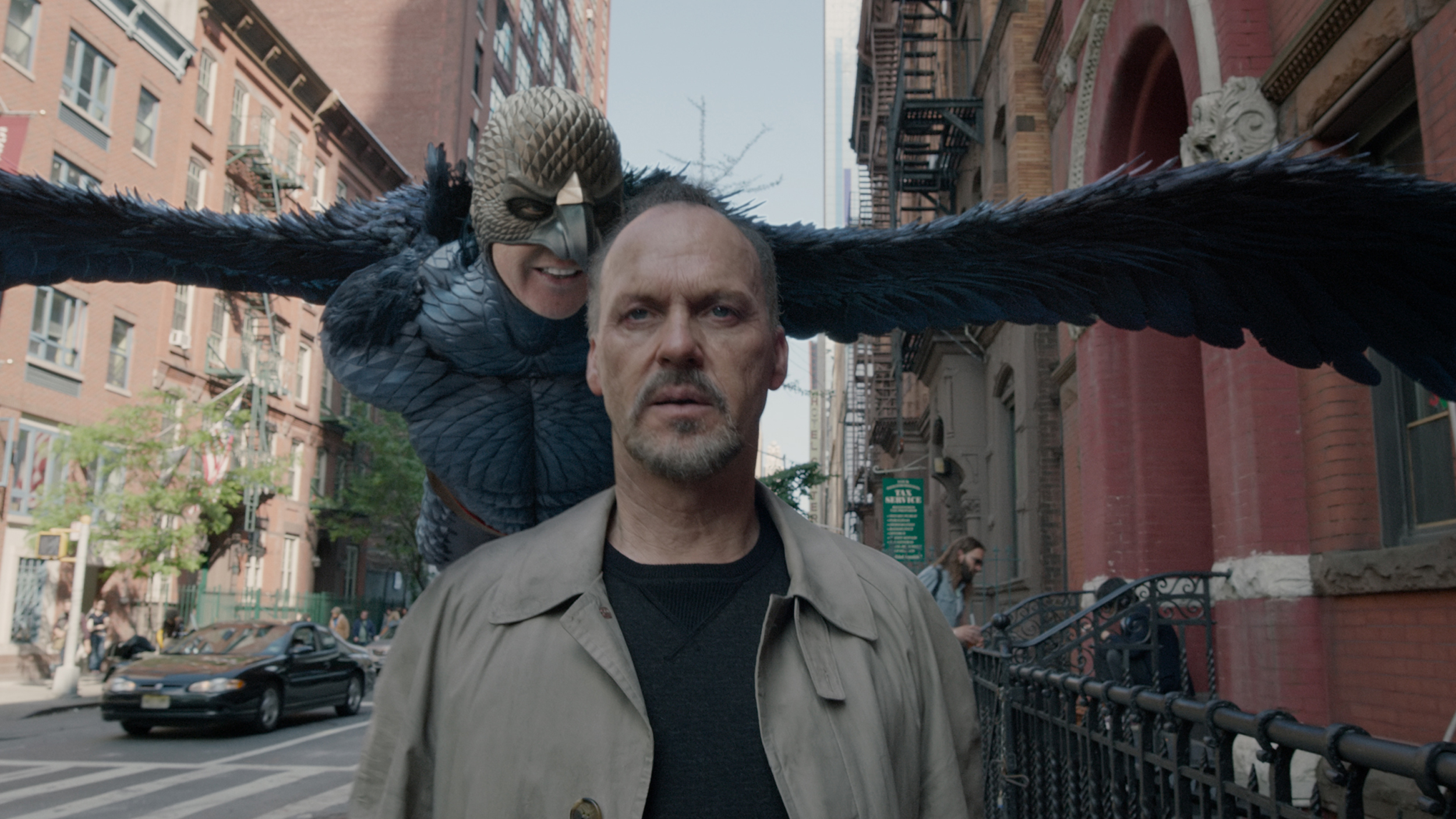
BirdmanBirdman or The Unexpected Virtue of Ignorance is Alejandro González Iñárritu’s (21 Grams, Babel, Biutiful) love/hate letter to the movie industry, a mixture of satirical send-up and insightful soul-searching that hinges on the legend of Michael Keaton. Keaton, who reportedly walked away from sequels to Tim Burton’s Batman (which set the stage for the current superhero film craze we’re living through), plays a version of himself, Riggan Thomson, who once walked away from Birdman sequels to be an artist.

In Iñárritu’s film, shot like one mostly-long take, Thomson directs, produces, and stars in a play he wrote based on Raymond Carver’s “What We Talk About When We Talk About Love.” An incessant (did it ever actually stop?) drumbeat rises and falls based on Thomson’s mood, thoughts, situations, providing a consistency that matches the cinematography (Keaton’s character meditates off the ground??). Iñárritu’s ‘take’ makes this one worth seeing, even if you’re not sold on Thomson’s interaction with his manager (Zach Galifianakis), his ex-wife (Amy Ryan), daughter and his personal assistant(Emma Stone), girlfriend (Andrea Riseborough), and boundary-pushing co-star (Ed Norton). But Keaton shows a range here, Birdman suit notwithstanding (did Christian Bale do those voiceovers?), that exceeds what we’ve seen in awhile. That makes it fun…

But the truth is this film is part-midlife crisis and part-existential soul-search. Sure, the play he’s doing might be his shiny red Corvette, but the internal struggle he experiences, played out with the ‘real’ Birdman who appears all around him, with the ‘superpowers’ that exhibit from the opening shot onward, with the way that Keaton plays Thomson like a real-life washout of an actor, a dad, a playwright, and a human being. This is far from fun, too, because even if it’s satirical of Hollywood, there’s something organic and human about it all, too.

You could probably go all Nietzsche or Plato’s cave on Birdman. There’s a saying, attributed to different people and cultures, that says we die two (or three) times: the first when our body ceases to function; the second, when someone last says our name; and the third, the last time your name is remembered by someone. Birdman shows Thomson’s struggle with that fear (some would say innate within all of us) of being forgotten, of never having belonged or having made a difference, all tied within the confines of his own career. Thomson spends much of the time worrying about being remembered, being known, being loved – in the microcosm of the play within the movie, and in the movie itself. But I think he’s truly freed from his fear (and the voice in his head) when he recognizes that he is loved in the real world, that he doesn’t have to act to be accepted.

Should Birdman be considered “great”? I’m not sure about that one yet, but I do know the direction is excellent, and that Keaton and Stone are solid in their character depictions. I know that the story, while pointing its grubby fingers at Hollywood, also speaks to our “ordinary” lives, where we long to be loved and known; we know we’re meant for something more and we can’t always figure it out. Can you find that outside of God? Some would say yes. Can you find it outside of community? I think that’s highly doubtful. Community gives us power, and tethers, and reminders of who we can be. Birdman seems to display a belief that we can’t be free until we’re okay in our own skin.

Seems about right to me.

Posted in Current Events, Movie Reviews, Pop Culture, Theology | Tagged , , , , , , , , , , , , | Leave a comment

New Rating System For Reviews (Movies, Books, TV)

This is one of those boring but necessary occasional posts that only the most avid readers of the blog will care about… if any!

But I’m unleashing a new review system and will be tweaking it (if necessary) over the next few weeks.

Drum roll, please…

give it: I thought it was terrific, and I enjoyed it/learned from it enough that I wanted someone else (a family member, friend, or someone seeking answers) to unwrap it and examine it, too.

buy it: I thought it was terrific and I want my own copy because I may revisit it at a future date.

borrow it: I thought it was better than average, but reading it once (thanks to the library), or watching it once (thanks to Redbox), would be sufficient.

rainy day it: I wouldn’t go out of my way to watch (read, examine) it but if you’re bored and there’s nothing left to consider, then I wouldn’t think less of you for checking it out.

burn it: I couldn’t finish it or found it to be so lacking that I hope my inclusion of said book/movie/TV show/etc. will save you from the investment of time in life that I can’t get back.

Any questions? Leave ’em below. We’ll see how this goes.

Posted in Books, Comics, Movie Reviews, Pop Culture, Reviews, Theology, TV | Tagged , , , , , | Leave a comment