Son Of A Gun: Ewan McGregor Shines (Movie Review)

When a petty thug, JR (Brenton Thwaites, The Giver), is imprisoned, he is taken under the protection of legendary thief Brendan Lynch (Ewan McGregor). Upon his release, he becomes a crucial cog in Lynch’s plan to steal gold, but JR’s interest in the mysterious Tasha (Alicia Vikander, The Fifth Estate) may prove to be his undoing. A lesser known film from Lionsgate, McGregor’s name sold me on checking it out, and it is ultimately his performance that lifts it from ordinary heist flick.

The prison life depicted in this Australian thriller proves some of the best scenes of the film, and they all come early on. After JR helps break Lynch out of prison, the action moves toward Lynch’s deliberation with Sam (Jacek Koman, The Great Gatsby), as they work toward the actual heist. It slows down considerably, even as JR pursues Tasha against his boss’ wishes and advice. Sure, there are a few gripping scenes, like when Lynch discovers Merv (Eddie Baroo) lied about why he was serving time, having assaulted a young woman.

Broadly, everyone in the film is some kind of criminal, but some are worse than others. We are drawn to McGregor’s powerful portrayal, but he also has a code. He urges his men not to kill, and certainly remains troubled by allowing Merv into the gang. There are things men should (or shouldn’t) do in Lynch’s mind, and it shows a certain value system that we expect of the “bad man with a heart of gold,” if there is such a thing.

Overall, it’s stylized and occasionally exciting, but the film doesn’t bowl you over with its story. If you’re looking for a rental, this might entertain you, but McGregor’s role is the one that steals the screen time. rating: rainy day it.

Posted in Movie Reviews | Tagged , | Leave a comment

The Bible Says What? God Kills… (Exodus 11-13:16) #6

passoverIf it doesn’t turn your stomach (at least a little) to think of millions of people dying when the rains fell and the floods rose in Genesis… How about the decision of God in Exodus 11:5 to kill every firstborn son, whether it was Pharaoh’s or a slave’s or a calf? When someone makes an argument that there was a different (or at least dualistic) god in the Old Testament who is different from “the Father” Jesus asserts in the New Testament, this is one of the moments they’re fundamentally struggling against. [For the record, that’s called Gnosticism or Marcionism, if you’re curious.] We’ll explore Passover in this particular outing, as I slow down from my previous ten and thirty chapter flybys. It just seems to go against the character of God as I know God… and there are no easy answers.

If you’re just joining us, this is the sixth in a series – my response to the secular “reading through the Bible” and responding available at your local Barnes & Noble. (Unless of course, it closed.) So I decided to tackle the impossible: read through and comment on the Bible. A chapter at a time, or maybe a whole book at a time, I’ve set out to read through and see what I see. Care to join me?

To be clear, Pharaoh has made Yahweh God his enemy. Sure, God ‘hardened’ Pharaoh’s heart, but we aren’t given much indication that God didn’t give Pharaoh anything more than the energy to continue on the path he desired. God didn’t make Pharaoh evil or cruel, but he allowed him to stay that way. So Moses goes in and offers up that the firstborn are all going to die and Pharaoh blows him off again. Well, to be honest, we assume he blew Moses off, because it says that “Moses, hot with anger, left Pharaoh.”

Wouldn’t you be upset if you knew someone was being stubborn, and that their destructive behavior was going to be there undoing? I don’t suppose at this point that Moses knew that the Egyptians would be drowned in the Red Sea, but here, he’s trying to save Pharaoh’s firstborn and every other firstborn, and Pharaoh won’t let the Jews go worship. Moses can see that God proved true to his previous nine promises of plague… so why wouldn’t God do what was promised here?

Now, in retrospect, this Passover event, where the angel of God/death passed over the Israelites and struck down Egyptian firstborn makes a lot of sense. It’s what will set up nearly fifteen hundred years later the Last Supper of Jesus, the crucifixion on the cross, and even Easter morning. It all makes sense looking backward, but it’s still hard to swallow that from this point, until the Jesus comes, that God strikes down children and nations.

I don’t personally believe that God strikes anyone down. If that was true, would terrorists exist, or really bad people? To be even more personal, why would God keep me around? I’m a sinful, broken, messed up human being, and God gives me grace. I believe that death is promised from the disobedience in the Garden of Eden. We’re all going to die, but those who believe in Jesus will live again. Is pre-Jesus judgment of individuals and nations just part of the whole process? Pharaoh made decisions on behalf of his people, to willfully choose sin, and this is God putting them out of their misery, or punishing them?

Honestly, I don’t know. Maybe one day, I’ll get it. For now, I don’t think it’s something we can prooftext into our politics or nationalism and think “well, God made it okay for us to strike down our enemies.” That’s garbage, whether you want to read the Old Testament into it or not.

What I do know is this:

God made it clear what would happen and who would do it. Not to beat on Ridley Scott (again) too badly, but there was no mistaking that God was the one sending the angel of death and keeping God’s people safe. It was no natural phenomena claimed as a miracle. It was God’s actions.

God told the people to see it as a new beginning. The Passover changed the calendar; the Passover was to be fantastically celebrated. It was to be a time when God’s people would recognize that they were special, sacred even, to God. God went so far as to set apart the Israelite firstborn as “God’s.” That was to serve to them as a reminder that the covenant was still in effect, that God continued to watch over the people.

God made the Passover about going, not about staying safe. Even before the Israelites would cross the Red Sea (in the next installment), they were to be on the move. Honestly, if you haven’t already considered whether there’s a god, or whether that god loves you enough to act on your behalf, how about God telling the Israelites that protecting them was to move them forward? They weren’t supposed to get comfortable. They weren’t supposed to stay in Egypt and abide by the torture they received. They were supposed to move out and up, to something better.

This is a classic case of what I wanted to explore when I set out to  do this. I’m troubled by the death, by the violence needed to free God’s people. It’s a moment where I thank God that God is God and I am not, because these decisions are so heavy. But I’m also reminded that we’re given so many chances to change, and to follow, and that when we don’t, there are heavy prices to pay.

Thanks be to God that the Passover happened in Egypt, but thanks be even greater that Jesus’ death on the cross was the ‘pass over’ for all.


Posted in Bible Says What, Books | Tagged , , , | Leave a comment

Run All Night: Gangsters, Vengeance, And Shame (Movie Review)

runallnightLiam Neeson stars in Taken 4 what Taken 2 should’ve been. As Jimmy Conlon, Neeson must defend his estranged son, Mike (Joel Kinnaman, Robocop, The Killing), from his aging best friend and boss, Shawn Maguire (Ed Harris). In the space of one New York evening, Jimmy must shake off his shame-induced alcoholic stupor, battle his old mates, and save the grandchildren he’s never met. It’s electric, thanks to the direction of Jaume Collet-Serra (Unknown, Non-Stop), and the gravelly-voiced sixty-three-year-old action star.

When Maguire’s son (Boyd Holbrook, Gone Girl) bites off more crime than he can chew, he kills the Albanians who come to collect their money. But Mike sees the crime and becomes a threat as a witness. When Mike’s declining hit man goes to smooth things over, he ends up killing Maguire’s son, and retribution is in order. Nothing but bullets will stop this war of wounded pride and dying hope.

The film was my second-favorite Neeson film, after the Lawrence Block-inspired A Walk Among Tombstones (also starring Holbrook), to come out in the last year. The way it was shot, New York City came alive as a character, setting a backdrop for the likes of peripheral characters to play their parts. Common, Vincent D’Onofrio, Holbrook, and Holt McCallany don’t have to do anything particularly awesome on either side of the cops and robbers battle, but the niches they carve out fit perfectly. This is Neeson, with a side of Kinnaman, against the world, with New York as the backdrop – specifically a Rangers game.

Ultimately, this boils down to a man looking back over his life and realizing he’s made mistakes, and that he now carries regrets. Jimmy believes he made choices to protect his family when Mike was younger, but Mike only sees that he left them alone. With the faces of the men he killed haunting his dreams, Jimmy’s alcoholism makes him the fool of the group, until he reverts to being the protector his family always needed. It’s a curious case of dealing with shame played out in a gangster movie; it’s not perfect, but it works. And the final showdown is certainly worth watching. Rating: borrow it

Posted in Current Events, Movie Reviews | Tagged , , , , , | Leave a comment

Your Lenten Soul (A Mustard Seed Musing)

What is Lent? What does it mean for my soul? 

Those are the questions I’ve been assigned to answer as part of another church’s Lenten series, and the ones I’ve been pulling apart, string by string, for the last few weeks in preparation.

Lent is of course the forty days from Ash Wednesday to Easter Sunday. But more than just a chronological mark off of dates, Lent provides me an opportunity to be introspective, to consider what it means to follow Jesus daily. In the process, I find that I have a long way to go to be like Jesus, that there’s so much to learn and do to be more like him. But I also find that in the reflection, I realize that doing more and being more isn’t necessarily the only answer. To experience Lent, I need to rest in the fact that Easter happened – it’s historical. Jesus died on the cross for the sins of the world, that Jesus would’ve died on the cross for just my sins, but because of God’s great act of love, Jesus rose again.

What’s been in the tomb won’t go back in the tomb. What happens in the tomb doesn’t stay there.

And that means that all my searching and seeking and struggling is what I need for me to grow, but the work has already been done.

I admit that I am a practiced multi-tasker. I once maxed out on my potential by (this is a true story): talking on the phone, carrying on an internet conversation, watching a movie, playing a video game, and having a snack. All at the same time.

But the thing is, I don’t remember what the movie was, I had to keep repeating what the person said back to me, and I’m pretty sure I lost the video game. But it was a good snack, right?

Too often, life can be like that – a lot of motion and very little payoff. Lent is the season of the year where I try to remember to slow down. (I’d love to say I do that at Advent, but I’m a pastor and who am I kidding?) Lent reminds me that the Jesus came so we could have abundant life here and now, and forever.

Lent reminds me that Jesus said, “Come to me, all you who are weary and burdened, and I will give you rest” (Matthew 11:28). Come to me, says Jesus, I’ll give you rest. I’ll give you a break. I’ll give you what you need.

To everyone who’s lost someone they love
Long before it was their time
You feel like the days you had were not enough
When you said goodbye

And to all of the people with burdens and pains
Keepin’ you back from your life
You believe that there’s nothing
And there is no one who can make it right

There is hope for the helpless, rest for the weary
And love for the broken hearts
There is grace and forgiveness, mercy and healing
He’ll meet you wherever you are

Cry out to Jesus — “Cry Out To Jesus”, Third Day

Those words remind me in song that we all have reasons to be beaten down, to be held back, to have bad days. And Jesus is the answer to the question. For me, Lent reminds me to go back to the source.

I was told I should share two things I do that are helpful for me at Lent. I’ll share and old one and a new one.

The old one is that I like to drive around with no music on, no phone conversation. My father-in-law never listens to the radio; I listen to it all the time! Sports talk radio, music, you name it. Or I can slide into using my commute to get work calls done on the phone. Especially during Lent, I like to turn everything off and just drive. And listen. Sometimes, the quiet is the place where I’m most amazed what God will say. If I’ll just shut up and listen.

The new one is one I read about in an article. An experienced pastor, maybe even a bishop, said that every year, they bought a new Bible. Now, there are Bibles and Bibles and Bibles in Christian book stores. They’ve marketed them down to the Southern hunter who prefers barbecue and only hunts with knitting needles. Christian sales know how to get you! But the pastor said that they bought a new Bible, and often a new translation, because it helped them read it in a whole new way.

I don’t have an eidetic memory like Sheldon on Big Bang Theory but I’ve read the Bible since I was a little kid, and I can kind of gloss over parts. So I thought this new idea was worth trying. And I decided I’d write about what I was reading. So once or twice a week, I’ve been writing about what I discover as I read the Bible “new,” and sometimes, folks even respond on my blog about what I’ve written. Reading the Bible in a new way let’s me hear God “fresh.”

So there’s my Lenten reflection: I think Lent slows us down and reminds us that Jesus calls to follow, to embrace the life of the disciple. I think a little silence goes along way, and having new eyes to see the wonders of God, helps too.

Posted in Uncategorized | Tagged , , , , | Leave a comment

Sunday’s Sermon Today: UN-cheap Grace (Gospel of Luke)

Sometimes, we want the payoff without the cost, without any effort.

We want to look svelte and sleek, but we want to eat whatever we want while we’re sitting on our couch watching television.

We want to know our financial futures are locked up tight, but we are used to spending money freely on today’s creature comforts.

We want to have great friends, but we fail to take the time in those relationships to listen, to care, and to grow.

We want the ultimate life but we often fail to consider the cost.

This man in Luke 18 today is just like us. In some gospels, he’s called “The Rich Young Ruler.” We understand that he is in the prime of life -that he has it all – with wealth, property, authority, and power. But he’s obviously been thinking about what it means to live forever, to have a relationship with God that would extend beyond this life.

So, he comes to Jesus and asks, “Good teacher, what must I do to inherit eternal life?”

Now, let’s be clear, he doesn’t think he’s talking to God or God’s one and only son; he is asking someone he thinks is wiser than the rest, who has something to offer him in knowledge.

Jesus’ response is a rebuff in its own right: “You’re calling me good but you don’t really know what you’re saying.” It’s ironic, and challenging at the same time. ‘You’re using a term that should be reserved for God, and I am God, but you don’t know or respect that!’

So, Jesus challenges the man with the Ten Commandments: don’t sleep with someone you’re not married to, don’t murder, don’t steal, don’t lie, honor your father and mother.

That’s a pretty heavy list, right? How many of us can say we’ve gone five for five on that list? How many of us have some work to do on the list before tomorrow?

But this guy says back, “I’ve obeyed all of those my whole life.”

Think about that a little bit. The ruler who wants Jesus’ advice is basically saying, “Yeah, I asked your opinion, but I’ve got this covered.” He came and approached Jesus as the expert, but he assumes that the answer is already justified – that Jesus is going to give him an “attaboy.”

[Honestly, I do that all of the time with doctors. “Okay, so I have congestion, cough, nasal discharge, etc. It’s got to be a sinus infection. Can you just write the Z-pack prescription? I don’t even need to come into the office!”]

The thing is, we can come to church over and over again, picking and choosing which of the commandments of God we’ll follow, and expect that God will give us an “attaboy” or “attagirl.” We can have been so selective about what to follow that we fail to see the things about our lives that we should give up or let go of because that’s what God wants from us!

But the thing is, that this ruler came to Jesus, expecting one thing, and receives another. Jesus puts his finger right on the pulse about what the man really cares about, what consumes him, what keeps him from living a freely-loving life: his stuff. His prestige. His power.

So Jesus cuts through it and says, “You’re still missing one thing. Sell everything, donate the proceeds to the poor, and then come follow me.”

It says that the man went away sad because he was very rich.

This concerns the disciples, because they are sure that the rich have a leg up on eternal life because, of course, the rich have a leg-up on everything, right? Society, since the beginning, has valued wealth above and beyond other characteristics. They ask, incredulously, “Who then can be saved?”

As in, “oh, man, if the rich can’t be saved with all they’ve got, then no one else can either…” This is despair!

And Jesus says, “What is impossible with man is possible with God.”

Salvation, following repentance, is not from humanity but from God. We can’t be saved on our own; we can’t be saved by what we have or what we get. We can only be saved by the the grace of God through the death and resurrection of Jesus.

That grace is freely given, but it cost Jesus something, didn’t it? He had to die on the cross. He gave up his life.

And Lent calls us to consider the cost of discipleship. We’re called to give up the things we don’t need – and the things that are destructive to us like greed, lust, addiction, power — and embrace God’s call for us to love.

We’re called to leave our comfort zones and figure out what we really believe. I’ve been thinking about that a good bit this week, since I watched the film Do You Believe? It’s the follow-up, but not a direct sequel to, God’s Not Dead. Now, I wasn’t a huge fan of the first one, even though it has its merits – and it asked people to consider what they were thinking about theology versus what the “world” told them was true.

In Do You Believe? a series of people, twelve in fact, are asked how they’re living out what they believe – whether it’s Christian or not. Are they making a difference in the lives of the people around them? Are they speaking the truth in love? Are they committed to answering to the fact that yes, they follow Jesus? Not all of them answer the same way – not all of them get it.

But the movie holds the toughest criticism for those people who say they love Jesus and yet don’t show it. Who don’t do anything about it.

Who know they shouldn’t do things or should do things but stand back and assume someone else will. They’re simple things but nonetheless, important ones.

The pastor will do the preaching for us….

Someone else will visit or call on the person we haven’t seen in awhile…

The more experienced person will share their faith with my co-worker…

The Sunday School teacher will explain everything to my kids so I don’t have to…

Like going to the doctor, we can’t get better if we don’t follow the doc’s instructions. If we don’t take our medicine, or get the rest we need.

Jesus called us to get up and go. To follow. He didn’t say it would make us miserable but he did say it would require sacrifice and there would be trouble.

Me personally, I’m down for a little trouble. But too much trouble and I… might be in trouble! But this isn’t on us; this is on God. If we’re willing to do what we should, put aside all the things we know we shouldn’t really be doing or thinking about anyway, and trust that following God ends up pretty well.

Jesus did the heavy lifting, and just asked that we’d believe. That we’d recognize God’s love and want to let God lead us the way we should go.

God’s grace is freely offered – but to receive what we’ve been given, we need to live the life God wants for us. The best for us. Right now.

Amen.

Posted in Sermons, Theology | Leave a comment

Top Five: Chris Rock On Chris Rock (Movie Review)

topfiveChris Rock wrote, directed, and starred in the social commentary/standup/ensemble/memoir/satire that is Top Five. You’ll buy or rent this for the cast, and then consider some of the things that Rock is saying about comedy, stardom, and what it means to “keep it real” when the camera is on or off. With turns by Cedric the Entertainer, Kevin Hart, Tracey Morgan, JB Smoove, and a host of others, the film’s comedy chops are unarguably solid, but no less than by the man, Rock himself. [Seriously, this might be his best since Head of State…] And yet, I’d argue that this is the most serious film Rock has ever made.

Rock’s Andre Allen is widely trashed as a washed-up comic because he’s “settled” for making million-dollar film franchise based on a cop-in-a-bear-suit called Hammy (think Martin Lawrence in Big Momma’s House). He’s about to marry a woman (Gabrielle Union) he feels obligated to but doesn’t love (and who doesn’t love him). She’s doing it for the ratings… and that’s the point. But Rosario Dawson’s Chelsea, the reporter writing a feature on Allen, is the one who asks the questions that ‘peel the onion’ or pull back the curtain on Allen’s life and asks him to be real.

Who loves you for you, regardless of whether or not you’re famous, valuable, or powerful? Ultimately, Top Five tackles our issues with love, relationships, and power, and the tricky blend of all three. Sure, it’s a mostly black ensemble cast using their combined fame to make something funny but there’s something deadly serious going on here that you can’t necessarily find in About Last Night. (But please, where else are you going to find Whoopi Goldberg, Jerry Seinfield, Adam Sandler, and Rock sitting side-by-side riffing?) Rock’s narrative takes us through alcoholism, the cost of fame, the abuse of relationships, and leaves us wondering what we think of those we idolize on the other side.

At one point, Union’s femme fatale of sorts tells Allen that he has to kiss her on camera, because “if it’s not on camera, it’s not real.” That’s more than just the zeitgeist of an industry-poking film (a la Birdman, no?) but rather a bigger criticism of our social media frenzy where everything must be documented, tweeted, instagrammed, and recorded for our own glorification. No doubt there is something to be said about the sharing of information, but when are we being really true to ourselves and when are we smiling for the camera? [I’d argue that the onslaught of “reality TV” has engendered the wearing of masks and creating of personas that would make the ancient Greeks blush…]

For a practical, more personal perspective… When you lose everything – when it all falls apart – who has your back? When you get to the moment in your life where you have to decide who you’re going to be for the rest of your life, who helps you make the decision? Yes, Top Five is funny, and the arguments over rappers, comedians, and actors is well-played, but the movie might challenge your worldview, too. rating: borrow it

Posted in Current Events, Movie Reviews, Pop Culture, Reviews | Tagged , , , , | Leave a comment

My Girl: Life, Death, & Adolescence (Movie Review)

Anna Chlumsky made her big break into the industry and Macaulay Culkin found something to do in between Home Alone 1 & 2, as a pair of adolescents who tackle love, life, death, and adolescence in the 1991 hit My Girl. This film is tabbed as a “comedy-drama” but (spoiler!) a film where a kid dies in the end is something heavier than the average Kevin Hart/Adam Sandler slapstick. But with Howard Zieff (The Dream Team) directing, it earns its fair share of chuckles.

My Girl tackles plenty of issues. Chlumsky’s Vada lives with her widowed father (Dan Ackroyd), who runs a funeral home; death is way more present in their home than the average adult couples’ lives! She also has to help care for her grandmother who has Alzheimer’s (several years before awareness of Alzheimer’s symptoms and care were so widely known). And then there’s her best friend, Thomas J (Macaulay), has his own issues, not the least is that bee sting allergy.

Remastered in 4K, the Blu-ray boasts the feature that looks at Vada and Thomas J’s first kiss, and the bingo scene between Ackroyd’s funeral director and Shelly (Jamie Lee Curtis), the makeup technician at the funeral home. It’s this second relationship that adds another level of drama: the dating relationship and remarriage of Harry, as a single, widowed father. Laurice Elehwany’s script really swings for the fences: it’s all of these issues poured in and heated to a boil that make the film powerful, complex, and heart-wrenching.

I’m not sure I could tackle watching it again, at least not soon. Yes, it’s powerful in its stories, but it’s also sad! Still, the film has fans everywhere and they’ll be clamoring to pick up this installment of 1990s retro drama ASAP.

Just watch out for the bees.

Posted in Movie Reviews, Pop Culture, Reviews | Tagged , , | Leave a comment

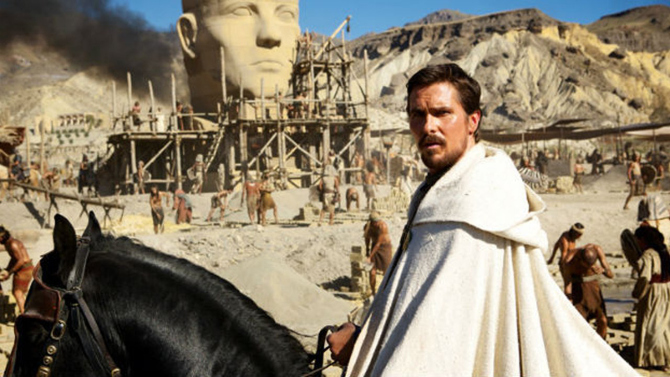
The Bible Says What? Not Ridley Scott’s Moses (Exodus 1-10 ) #5

exodus-gods-and-kingsGenerally speaking, I like movies that look at the Bible, even if they’re done by people whose worldview differs from mine. I don’t dig Darren Aronofsky flicks, but his Noah gave me some food for thought (and definitely made me think about those outside the ark). But Ridley Scott’s Exodus: Gods and Kings seemed to be an exercise in exploring tenacious brotherhood, more than a Biblical exploration; the fact that Scott’s brother Tony had committed suicide months prior to the film’s release seemed to indicate that. Re-reading the opening chapters of Exodus, I am reminded again of this truth that Scott missed out on: God is present, faithful, and active for the people’s good.

From the beginning of Exodus, we see that the Israelite numbers/power have the new Pharaoh assuming the worst: a riot might take place. But God’s people respond to the oppression by growing (1:12), and their women are sturdier than the Egyptian women (1:19) in a hilarious inclusion in the text. But the Pharaoh escalates from persecution to annihilation with his order for all newborn males to be put to death (1:22) and this becomes deadly serious.

Moses undergoes a sort of ‘baptism,’ being brought out of the water to new life (2:5-6), much the way that his people will be brought through the Red Sea to new life (Exodus 14). The flash forward takes us to Moses’ young adulthood, the murder of an Egyptian overseer, and the flight to the home of Jethro. But things get really interesting when God decides to intercede in physics, biology, and chemistry by visiting Moses through a “bush that doesn’t burn up” (3:3).

exodus2Where Moses meets God is declared to be holy ground (3:5) not because the place is holy but because God is there. Stop and consider that one for a minute: what would change about how we see the world if we see it as holy when God is present versus going to places (churches, synagogues, mosques., etc.) and invoking God? Doesn’t that change our perspective on the holy, and on how we value time and space? But God doesn’t stop there (or maybe it’s that God continues that line of thinking): God tells Moses that God will be with him when he goes to speak to Pharaoh, and that worship will occur on Mount Sinai when the people leave Egypt.

Again, this is not a god tied to a specific time, space, or situation; this is the God who wrestled with Jacob in the middle of nowhere, who was with Abraham and is now speaking to Moses as part of the covenant, who can go (and control) whatever God pleases. The ‘worship game’ has changed.

When God declares “I am who I am,” it gives me chills (3:14). We can minimize creation to being like Gepetto creating Pinocchio in the wood shop, God forming Adam out of some dust and breath. But when God says God always was/is/will be, there’s the implosion (a big bang if you will) of space spreading all around us that suddenly threatens to unload an immensity we can’t wrap our arms around. God can’t be contained, quantified, or measured. God merely is – and, in this case, Moses is drawn into a relationship, because God wants to intercede on behalf of the people.

This God that Moses knew of but had not previously worshipped prophecies/predicts that the king of Egypt won’t respond well to the demands for worship. God gives the reluctant Moses signs to perform, miracles intended to show that Moses has a particular set of skills  – but they’re just the warm-up to the plagues God will unleash on the Egyptian people. There’s a curious dynamic there though: God gives Moses all of these “tools” but continues to “harden” the heart of Pharaoh. I don’t think it’s the arteries snapping shut from too much bacon, but rather the closing down of his ability to reason, find compassion, really – God allows Pharaoh to back himself into a corner.

Pharaoh certainly does that – all the way through the plagues of blood, frogs, gnats, livestock, boils, hail, locusts, and darkness. But then the plagues become more than topical, more than economic or uncomfortable. God ratchets it up in Exodus 11 – which I’ll get to next – proving that there comes a time when God has had enough.

But Moses’ story (which is far from finished) reminds me again of the way God works: God called a broken man, an outcast man (from two origination groups, no less!), an insecure man to be the leader of God’s people. God saw in Moses what Moses couldn’t see in himself, and God was willing to patiently use and empower Moses to make good come from evil. That’s part of the story I don’t see in Exodus: Gods and Kings – how God looks inside our hearts and brings out the best of us. But in the exploration of the Bible, there is no one less-heroic-turned-hero than Moses. There’s more to his story, webs we haven’t yet untangled, and it raises questions about how we see ourselves and what God would really do with us if we went…

Moses is one of my favorites – maybe even the one I relate to the most. What Biblical figure do you best relate to and why?

Posted in Bible Says What, Books, Pop Culture, Theology | Tagged , , , , | Leave a comment

The Bible Says What? “Fathers & Sons” (Gen. 20-50 – Speedy Version) #4

Father & SonThe story of Genesis gets us to this point: God made that covenant, that agreement with Abraham, and now, it’s passed down through Abraham’s son, Isaac, to his son, Jacob, to Jacob’s sons. To understand where that covenant ends up, we’ll investigate the subsequent chapters of Genesis beginning with the birth of Isaac.

Isaac is pretty much a placeholder between ole Abe and Jacob… except for his childhood. In Genesis 22, God tells Abraham to “take your sin, your only son, whom you love and go… sacrifice him as a burnt offering”. [Cheating aside: John 3:16 sounds pretty similar doesn’t? “For God so loved the world that he gave his one and only Son, that whoever believes in him shall not perish but have eternal life.”] There’s part of me that wants to scream, “Abraham, what in the world are you doing?!!” But Abraham goes up the mountain, the obedient son (of the covenant) and the father (of Isaac), too. Isaac asks what’s going on (perceptively) and Abraham says God will provide the lamb (Gen. 22:8). Hebrews 11 will have some things to say about Abraham’s faithfulness but this is a less discerning faith than I think we talk about today. Could you pursue a path that involved sacrificing your own child? I couldn’t. It’s not fair to say “well, God provided…” when Abraham didn’t actually know it wouldn’t be Isaac… Let the arguments begin over that one!

Sarah dies. Isaac gets a wife (Rebekah). And then Isaac has two sons – he picks the manly one, Esau, as his favorite and shuttles his lesser son, Jacob, off to Rebekah. Does the blasé (?) near-offering moment of his childhood cause the disconnect in how he parents, or is it something else? Whatever it is, the favoritism causes discord, the mothering manipulation creates a divide, and Jacob runs away. Jacob prays to a God he doesn’t yet know, who he doesn’t believe can follow him or precede him because his understanding of a god is tied to a place and time. But God shows up, watches over him and he ends up with two wives, children, and lots of “stuff.”

But it’s not until Genesis 32:9 that Jacob really prays: “O God of my father Abraham and God of my father Isaac, O Lord who said to me, ‘Return to your country and to your kindred, that I may do you good,’ I am not worthy of the least of all the deeds of steadfast love and all the faithfulness that you have shown to your servant, for with only my staff I crossed this Jordan, and now I have become two camps. Please deliver me from the hand of my brother, from the hand of Esau, for I fear him, that he may come and attack me, the mothers with the children. But you said, ‘I will surely do you good, and make your offspring as the sand of the sea, which cannot be numbered for multitude.

We’re back in Abrahamic covenant territory but this time, the ‘lesser’ (the human) is praying to God with an actual request. And we know God responds because next up, Jacob wrestles with an angel/God, refuses to give up, and earns a new name (Israel) that will be passed down as the name of the Jewish people’s nation. [I’m going to slip past the actual Biblical narrative of Genesis 34’s Dinah – not to be confused with the fictionalized recharacterization by Anita Diamant. But yes, Jacob’s sons are infuriated by their sister’s rape, so they trick a foreign nation into circumcision – and then kill them while they’re incapacitated. I guess there was no March Madness deal at the local urology company.] And then, we get back to the stories of fathers and sons…

Jacob shows favoritism to Joseph (coat of many colors in Genesis 37) and sets off a strange series of events, where Joseph’s death is faked, he’s sold into slavery, he becomes the main man in Potiphar’s house, he gets accused of rape, he ends up in prison, he interprets some dreams thanks to the power of God, and becomes the COO (chief operating officer) of Pharaoh’s storehouses just in time for a famine. You can’t make this stuff up – from top to the bottom, to the top to the bottom, to the top… and all over again several times. It’s like something out of a daytime soap: all of the family drama that plays out again and again.

Fathers who don’t know how to raise men. Men who grow up resenting their father or their brother or both, who then don’t know how to be fathers themselves. Sure, God used these men to pass down the covenant, but sin is out of the bag – it’s loose in the world, and the impacts are embedded in the DNA of family. When we fail as people, as children, as parents, it’s part of the social DNA since the very beginning. [Okay, not the very beginning – everything was good then.] But is it any wonder that we struggle, claw, and scratch our way through our family tree and interpersonal dynamics? We make the same mistakes, or find ways to make new ones. We’re broken.

[Speaking of broken, take a sidebar moment and read Genesis 38, the story of Judah and Tamar. Judah takes Tamar as a wife for one of his sons, who dies. By all expectations, Judah’s next son would then take Tamar as a wife to give her sons, but he doesn’t because he doesn’t want the aggravation (and he won’t get the ‘credit.’) So Tamar tricks Judah, her father-in-law, into sleeping with her and gets the son/offspring she needs. It’s another strange sexual interlude – the nakedness of Noah, the drunken use of Lot – in an ongoing plot about Joseph, just hanging out there. Another one we don’t push in Sunday School, but one has to think there’s something we’re to learn about fulfilling our moral obligations, and the price we pay when we fail to put community first. Oh yeah, and you don’t want to mess with a widow!]

But still, somehow God shines through. Somehow, God works in our hearts to “make things new.” Take Joseph as my closing argument. He had plenty of reason to be angry, to hate, to resent, to want revenge. In Genesis 50:19-20, Joseph states, “Do not fear, for am I in the place of God? As for you, you meant evil against me, but God meant it for good, to bring it about that many people should be kept alive, as they are today.” God was faithful from Abraham to Joseph, even though bad stuff happened in the DNA of fathers and sons. But each son had to make a choice, and Joseph choose to do life differently: he recognized that he was not God, and he choose forgiveness over hate, love over revenge. Can we do that in a world where families are broken, where daytime soaps are lived out in our cul-de-sacs, where people think relationships are for using, not growing?

It’s about to get rough for the Israelites in Exodus, but thanks to Joseph, Genesis has a happy ending.


Posted in Bible Says What, Books | Tagged , , , , , , , , | Leave a comment

The Breakfast Club Blu-ray: When Labels Become Unstuck (Movie Review) #TBT

bfclubJohn Hughes’ follow-up to Sixteen Candles bears its thesis in the opening and closing voiceovers of the film. It’s a before and after shot of what it means to be a teenager, to be human, to “come of age,” and to struggle with the “powers that be” who lord over, determine, and control our lives. Some of them are more benign than others, and then again, some of them are Principal Dick Vernon (Paul Gleason).

“Saturday, March 24, 1984. Shermer High School, Shermer, Illinois, 60062. Dear Mr. Vernon, we accept the fact that we had to sacrifice a whole Saturday in detention for whatever it was that we did wrong, what we did was wrong. But we think you’re crazy to make us write an essay telling you who we think we are, what do you care? You see us as you want to see us, in the simplest terms and the most convenient definitions. You see us as a brain, an athlete, a basket case, a princess and a criminal. Correct? That’s the way we saw each other at seven o’clock this morning. We were brainwashed.”–Johnson (Anthony Michael Hall)

There’s the athlete, Andy (Emilio Estevez), the princess, Claire (Molly Ringwald), the troublemaker, John (Judd Nelson), the basket case, Allison (Ally Sheedy), and the nerd, Johnson. They’re tormented for different reasons by Vernon, and the school janitor (John Kapelos). But ultimately, they’re most troubled by the level of expectations heaped on them by their parents and the various levels of second-guessing that come from the way adults see them. They have come to believe the labels and ‘pigeon-holing’ that they’ve experienced their whole lives.

Is it funny? Absolutely. But it should also trouble anyone with a reasonable amount of influence on younger people (of all ages). Labels stick. But this special edition, digitally remastered and fully restored from the original film elements includes enough bonus features to let us dig into the material a bit. There’s a trivia track for fun, and then it gets a bit more insightful: “Sincerely Yours” (in twelve parts), “The Most Convenient Definitions,” and commentary by Hall and Nelson. If this film was one of your funnier memories of the 1980s, then you’ll appreciate the amount of coverage of the film gets here.

But I’m still moved by my latest viewing, especially by Bender’s recounting of the way his mother and father relate, and the way he is subsequently treated by Vernon. Kids believe what they hear – and teenagers aren’t much different. Words hurt, and leave lasting scars. We as a society are guilty of not caring about that enough.

Still there’s hope. Sometimes, a moment or a person breaks through and sees us the way we want to be seen, or the way we could be seen. In this case, it’s the motley Wizard of Oz-like crew who sees each other like new, for the first time. And everything changes, beautifully. Maybe it takes more than this – it usually takes time. But The Breakfast Club proves sometimes, we can actually change, with help.

“Dear Mr Vernon, we accept the fact that we had to sacrifice a whole Saturday in detention for whatever it was we did wrong. But we think you’re crazy to make us write an essay telling you who we think we are. You see us as you want to see us – in the simplest terms, in the most convenient definitions. But what we found out is that each one of us is a brain, and an athlete, and a basket case, a princess, and a criminal. Does that answer your question? Sincerely yours, The Breakfast Club.”– Johnson et al.rating: buy it

Posted in Movie Reviews, Pop Culture, Reviews | Tagged , , , , , | Leave a comment