AHA: Embracing Your Inner Prodigal (Book Review)

Are you a fan or a follower? Have you put aside all of your ‘gods’ so that God can be at the center of your life? These are the questions that Kyle Idleman, teaching pastor at Southeast Christian Church (Louisville, Ky.) has asked in his previous books. Now, he challenge his readers to consider the ways they need to turn back to God for guidance and peace through the Parable of the Prodigal Son, told by Jesus in Luke 15, through an “aha” moment. Want to go deeper in your relationship with God? This is a good place to start.

Idleman’s writing style is a mix of humorous (and poignant) anecdotes and theology that blends historical and experiential points of view. The pastor/teacher has an easy-to-read delivery that seems conversational and intimate without ever breaking into sloppy or flippant, and we feel like what he has to say is material he’s processed already. It’s easier to be critiqued when he’s critiquing himself, but it’s a straightforward critique of where we fall on the prodigal son’s timeline.

Idleman’s three main ‘acts’ are Sudden Awakening, Brutal Honesty, and Immediate Action. He encourages us to reflect introspectively on our lives and not wait for something tragic to change our trajectory, but to turn away from whatever the problematic behavior or attitude is. (It could be big like not-faith to faith, or a subset category of a life of faith.) The anecdotes are reasonable, both negative as problems to avoid and positive as a means of a person turning their life around. My favorite story is about Jonathan Haidt’s psychological test for how people would examine a life story and decide what to edit out to make it better, versus accepting as a means of being driven closer to God.

In the second section, Idleman grabbed me (and the human experience) with a story about Dateline (or a Dateline-like show) examining hotel rooms for what real clean looks like. We all have a tendency to deny how things really are, and Idleman pushes for us to be honest with ourselves and each other. His focus includes the excuses we make instead of being honest with ourselves, and that alone is worth it.

Finally, in the third section, we explore the way that awareness plus honesty should lead to action. We see the things we do (or don’t do) even when we know we should, and Idleman uses our health as an example. I was a fan of the story about heart surgery survivors who don’t improve their health after the surgery because their aha moment hasn’t actually changed anything. What we do with the information matters, and that matters.

Aha: Awakening, Honesty, Action gives us a good overview of the Parable of the Prodigal Son with Idleman’s insight, humor, and experience. It also challenges us to consider what changes we should make in our lives and what could be if God was at the center of our lives, if we’d recognize that God loves us like that. 

Posted in Books, Pop Culture, Reviews | Tagged , , , , , | Leave a comment

The Winter People: How Do You Handle Grief? (Book Review)

We have a hard time with death. We all know we’re going to die, from the moment of self-awareness to the moment when we breathe our last breath. In Jennifer McMahon’s latest novel, The Winter People, she takes West Hall, Vermont, and uses it to set the stage for a grieving process, with splashes of ghost story and mystery that suck the reader in and evacuate all of the breathable oxygen. Entertaining and lifelike, Winter People will leave you wanting more, and reflecting on your own pattern for dealing with grief.

In 1908, Sara Harrison Shea journals about the strange events surrounding the death of her daughter, Gertie, concerning her husband and those in the town around their isolated home in the woods. In the present day, Ruthie Washburne’s mother disappears, and she searches for answers, aware of the legend of Sara and the way that the community has insulated itself. Several other stories intersect with Sara’s story, and with Ruthie’s, but McMahon weaves the narrative in a way that it jumps from 1908 to the present and back, and from perspective to perspective, without losing us, but drawing us in deeper.

As a fan of both Stephen King and John Connolly, I found myself admiring McMahon’s ability to blend the spiritual with the tangible, the threat of evil with the power of community. Whether you get to the end of one of those novels and recognize that it is in fact real people doing real evil, or spiritual forces of evil doing evil, it doesn’t matter: good has to stand up against it. The multifaceted way with which McMahon spins the story, we’re kept unbalanced, not sure how to feel about these people or who exactly is the “good” until deep into the narrative.

Ultimately though, McMahon has spun a story that asks us to consider how we deal with loss, especially the loss of a child. What are our coping mechanisms? Are we inundated with platitudes, stupid things that people say, like “God just needed another angel?” Or are we moving forward, just merely surviving, one foot in the front of the other? Do we believe that there is something better that we can hold onto, some hope of seeing those we’ve lost again, in a better place, an eternal life?

I hold to those beliefs, that Jesus’ death on the cross frees us to an eternal life. But I also believe that life starts now. I don’t think that secondary life matters as much if we don’t grasp love in the here and now, if we don’t truly live. McMahon’s book, in its own way, wrestles with what happens when our grief becomes our life, when we don’t learn to really live, and what we attempt to hold onto instead becomes a death sentence, an evil unto itself.

In the end, The Winter People isn’t a book that has let go of me yet, but instead still lingers, like a shadow, asking me how I deal, and how I grow as a person. It’s a wonderful, mysterious tale, that bears reading, and reflecting on, when it comes to life.

Posted in Books, Reviews, Theology | Tagged , , , , | Leave a comment

The Well-Played Life: Play Hard (Book Review)

Leonard Sweet says the Protestant work ethic has made us believe we should always work hard. But he says that we’re actually intended to play hard. Working his way through three stages of life, Sweet calls us to “get in the game,” and stop working ourselves to death. He admits it’s hard, but points out that the consequences are epically in our favor if we would play more. Who wants to get on the field?

It’s typical that Sweet would mix in anecdotes, stories, and his own life through the narrative flow, but from the very beginning, I was struck by the heavy weight of what not playing looked like. Sweet recounts the stories of three pastors who died too early, having served what my mentor calls “a cruel mistress,” the church. How do I not become like them? I ask myself. How do I avoid the sentiments of older pastors who say they worked late at church most nights, and their children went from 12 to 30 in the blink of an eye?

But don’t worry: this isn’t just for ministry types. Sweet’s stories are classic illustrations, from the man who walked on the railroad tracks because he didn’t know he got to ride the train to the man who called out by name in a wedding to the organist and reduced the whole congregation to neil-ing. Sweet is a deep, deep thinker but his wicked sense of humor is what sets him a part when it comes to reading his books. His ‘parables’ hook you without you knowing that they’re really, secretly, pulling open your own viewpoint and asking you if you don’t need a change in perspective. (I’ve always seen it as the Mary versus Martha principle from Luke 10:38-42 but the development of our personalities and place in life over time takes it to a deeper level.)

Sweet asks several questions through the course of the book which ultimately answer whether or not this book is for you. What defines you, your work or something else? What is your purpose, to work hard or something else? What makes your heart sing, your work or something else? Those are questions which Sweet explores theologically, and which I’ve been asking a lot lately. (Readers of the blog know that the book Hands Free Mama has stirred in me a desire to be more fully present, to enjoy life more fully, to share real time with people and not what’s left over.) You can also find a discussion guide for your own reflection or in a small group in the back of the book, and I find those to be helpful as well.

Sweet puts himself out there, in his own introspection, and its what makes this better than any self-help book, but a conversation with a wise sage who knows that the right blend of humor, criticism, theology, and story will make us better than we were before. This is why I wholeheartedly recommend The Well-Played Life and encourage you to ask yourself, is it time I embrace playing, creativity, and joy?

Posted in Books, Reviews | Tagged , , , , | Leave a comment

Kyle Idleman’s AHA: Pastor Shows Authenticity (Interview)

I almost forgot to ask him about his new book, Aha: The God Moment That Changes Everything. Kyle Idleman, teaching pastor at Southeast Christian Church (Louisville, Ky.), is just that likable. Before I knew it, he was asking me about the website (HollywoodJesus.com), my church ministry, and the things that God was calling me to. My admiration for the heart behind Not a Fan and Gods at War grew as we talked, but we finally settled in, and I asked him questions about his new “God help” book, aimed at recognizing God’s call on our lives.

Idleman is the son of a seminary president, former church planter, and father of four, and his desire to model authenticity (“which often means confessing when I’ve done something wrong, and reinforcing that we do the right thing with the right heart”) shines through his latest book. After preaching through a sermon series on “The Parable of the Prodigal Son,” Idleman used the opportunity to gather up not only the teaching points from the scripture used in the series, but also the way that God’s spirit had moved in the lives of the people in the community who received it.

One of my favorite pieces in Aha is about our need for “Courageous Friends,” those who will challenge us to examine our lives and live it better. The book talks about one of Idleman’s friends, a personal trainer, who asks him how his workouts are going, even though he knows Idleman has been slacking off; another friend points out when Idleman is dressing like a 1980s retro casualty. But in our interview, Idleman pointed toward a friend who he meets with weekly, who helps him ask, “‘What am I missing?'” The relationship there leads to awareness, not because the other person tells him what’s wrong but because he helps him answer the questions for himself.

We talked about how that awareness of ourselves leads us to an ‘aha’ moment about God. “The greatest aha moment is when I recognize that I can’t help myself,” Idleman says. “As pastors, we can send mixed signals, ‘here are the six steps,’ but the Gospel really says, ‘I can’t do it on my own.’ We need to humble ourselves and pray for ‘aha’ moments.”

Psychologist Jonathan Haidt plays an important part in the new book, as his study about what we would edit from our own child’s life was shown to participants, who edited out all of the ‘bad stuff.’ “As a parent, our instinct is to protect our kids from life’s challenges, and sufferings, but in our own experience, that’s when we can show people that God has been revealed to us most clearly,” Idleman says.

Idleman points to these moments as times we think we should look for God’s ‘aha’ rather than pushing them away. In the book, he tells stories about individuals with eating disorders, drug abuse, and alcoholism who recognized that they were letting something else fill up the God-sized hole in their lives and had their ‘aha’ moment at the bottom. Just a few weeks ago, Idleman preached to a prison chapel full of inmates and asked them about their moment; the inmates unanimously said that their incarceration was their worst moment but also their best, because they met God in prison.

Everyone “reaches a point where reality is pressed upon us,” Idleman says. “It’s a matter of time where they can turn to God now, or recognize later, more desperately, that they’re dependent. But it’s going to be much harder on them.”

Idleman’s hope is that the book will push people from self-help to God-help, and that they’d recognize that God loves them unconditionally. He’s dedicated this book to his four children, and he says that he hopes that they will see in him, and in God, a father who loves them even “when the stains have been revealed, who runs toward them with grace and arms wide open.”

The book hits shelves March 1st- check back for a review!

Posted in Books, Current Events, Interviews, Reviews, Theology | Tagged , , , , , , , , | Leave a comment

Sunday’s Sermon Today: Who’s Invited? (Luke 14:15-24)

If you were having a party, and you could only invite one person, who would it be? Five people? Fifty people? Obviously, the more people you could invite, the less selective you have to be.

The thing about Jesus’ “Parable of the Great Banquet” is that the man throwing the banquet isn’t all that selective. He’s hosting a great banquet, with much expense and great extravagance, and he invites “many guests.” It doesn’t sound limited, but rather, it’s open-ended.

But consider this: “they all began to make excuses.” Not one, not two, not three… ALL.

One man explains that he’s just bought some property, and he needs to go check it out.

One man says that he’s just purchased ten oxen, and he’s headed to try them out.

One man said, I just got married so I can’t come.

Now, each of them is very polite in their refusal, “please excuse me,” but they all reject the generous offer of the host. Not only would that be insanely uncomfortable for the inviter, but it’s also pretty rude in that society standard.

Every year, the champions for the NBA and NFL are invited to the White House to meet with the President. And every year, some athlete says he won’t go because he doesn’t like who is in office. Republican or Democrat, it happens every year without fail.

And every year, I shake my head.

There’s the whole part of “no I in team” when we set ourselves apart as better than the body, and make a fuss that takes away from what the team accomplished.

And then there’s the fact that this is the WHITE HOUSE and the PRESIDENT OF THE UNITED STATES. I mean, seriously, I don’t care who they are and if I don’t like them, it’s still the opportunity of a lifetime.

And that’s what these invited give up.

The parable says that the banquet thrower became angry and that his servant is sent out to go into the city and bring in the “poor, the crippled, the blind and the lame.” It’s not into homes, but into the back alleys and rundown places, to find these people and bring them in.

And the servant reports back that there is still room.

So the master tells him to go anywhere and everywhere  and “compel them to come in” to fill up the house. But those first invited folks? They have no place there. 

On one hand, it’s a very openhearted, compassionate, warm-and-fuzzy parable, but we have seen over the last few weeks that parables aren’t really warm and fuzzy. They bite! And this one does, too, in its rejection of the first-invited who turned their backs on the master of the house.

I’d like to break this down on several levels.

First, there are the players. We can see God as the master of the house, preparing the world and all eternity for the appreciation and enjoyment of his people. We can see that God has made a covenant with the Jewish people or all believers and that they are invited into his glorious banquet. There is the servant who goes out, who might be Jesus or better yet, the disciples of Jesus (even us!) who have taken the word of God out into the world to share it with others. And like the “parable of the sower,” there are several layers of people who accept or deny the invitation.

Second, there are the excuses. Oh, man, there are excuses.

The first is about possessions: I have purchased some land.

The second is about work: I have purchased ten oxen to help me work harder.

The third is about relationships: I have gotten married.

Now, ask yourself, how many times have those kinds of excuses “prevented” you from… coming to church? attending Bible study? reaching out to someone else with the good news of Jesus? giving all of you had to the church financially or in terms of service? having a quiet time of prayer with just God? reading your Bible?

These are timeless excuses, aren’t they? And they defy the conventional expectations of societal norms. In fact, they are a way that we have come to explain our lives. We’re too [fill in the blank] to do that, so it’s okay that we don’t, because we have that excuse!

Family in town? Skip church. Work too hard last week? Skip church.

Too much work on the yard? Hit the couch rather than read the Bible

Forgot to pay your taxes? Don’t worry about giving missionally.

We excuse ourselves and we come to believe the excuses are more important than the thing we once knew was important. We devalue the “banquet” and focus on the effort of our excuses.

Third, the master of the banquet tells his servant to “compel them” to come in. He doesn’t give up just because the initial people have excuses. God isn’t about to say, “well, okay, I didn’t get their attention, so I’ll just let this one slide…” No, God keeps coming. God is proactively searching for the least and the lost, and modeling what he expects that his followers will do.

He expects that some who have been ostracized and left alone and who fall into the never invited camp will need to be convinced. And God sends out his servants to make that happen.

Fourth, the people who are brought in are the least, the last, and the lost. They are the uninvited. If we rewind our story to early in Luke 14, we see that Jesus was invited to a Pharisee’s, a religious leader and high on the totem pole political type, house. They invited him to test him, to see if he was or could be made into one of them. And they sat around in a big back rubbing session where they glad-handed each other and talked about how awesome they were. And they argued about who was the most important of them.

So this sermon was Jesus’ reframing of what a banquet looked like. He told the host of this particular party to invite in people who couldn’t return the party. You know, you invited me to your party so I’ll invite you to mine. Jesus said they should invite in the people who wouldn’t get to experience a party without their generous invitation.

We have social conventions for eating. We use utensils when eating. We wash our hands before dinner. We try to chew with our mouths closed. All of these are social conventions we understand and abide by and try to teach our children, but they are not necessarily the same as another country or time.

Jesus was telling his listeners, the uppity high-and-mighty, that God expects a different kind of hospitality to be offered because that was the kind of hospitality that God offered. 

God who created a world and made it good for us to enjoy.

God who made a covenant with his own creation when he didn’t need anything from them.

God who surrendered his own son to death on the cross to save that same creation.

God gets hospitality. And he wants us to understand it, too. God wants you to understand that you don’t need to stay outcast, or misfit, or on the outside, anymore. God wants to invite you in because God is always working to make outsiders into insiders.

So what happens if we do get it? What happens if we recognize that the new plus-one isn’t about taking a date to the party but about going one level past our comfort to share the invitation?

What happens if it means inviting someone who has never been to church before? What happens if it means sharing our story with a family member who has been ‘burned’ by church in the past? What happens if it means having that conversation with someone random person, just because they look like maybe they need to hear some good news?

In John 14:2, Jesus says, “In my Father’s house are many rooms. I am going there to prepare a place for you.” What can we tell about heaven from that one verse? What can we tell about this banquet that is already underway and lasts forever?

-We are part of God’s family. We are first place finishers.

-There is plenty of room, and we don’t have to worry about overcrowding or “not enough.”

-There is familiarity and hospitality for all of Jesus followers, that being invited and participating means there’s a front row seat to the festivities.

-It is OURS, we are active, real participants who get to help create it in the here and now.

At one time, we were the least, the last, and the lost. The uninvited. If you aren’t 100% Jewish, you were on the outside looking in because that’s who the “invited,” the covenanted, were. But Jesus broke through that and made it an open invitation to all.

If you haven’t ever really committed to that, it’s time you did. It’s time you reflected on your life, and whether it was the moment when you needed to lay aside your excuses, and say, “yes,” to God’s invitation.

The banquet is open to us, we know about it because we’re sitting here reading or listening to this, but how we respond says a lot about us. We’re supposed to invite others in our words, our actions, in our actual invitation to talk about God, to Christian events, to church. So why is our church, why are so many churches, not bringing new people in every week? How can we say we get it and not actively, daily, weekly, do something about it?

Check out this video of Penn Jillette (if you have a moment).

Jillette asks, “How much do you have to hate someone to believe that everlasting life is possible and not tell them about it?” That’s coming from an atheist. Pretty hard core, right? But in truth, we can’t say we love or like someone too much if we’re not being upfront about the invitation, if we’re not calling them from the hustle and bustle to come into the banquet.

I wonder sometimes what it would look like if we were willing to invite people. If we were willing to say, “this is my church and here’s why it should be your church, too.” Would more people be here next week?

We know they’re invited. We know we’re invited.

The truth is that this invitation to the banquet is wide-open and all are welcome.

But you still need to RSVP.

Posted in Current Events, Pop Culture, Sermons, Theology | Tagged , | Leave a comment

Sunday’s Sermon Today: Find Home (Luke 15:11-32)

Have you ever read a book that changed your life? I know I have. There are a few of them. In His Steps by Charles Sheldon. Not a Fan by Kyle Idleman. Hands Free Mama by Rachel May Shelton.

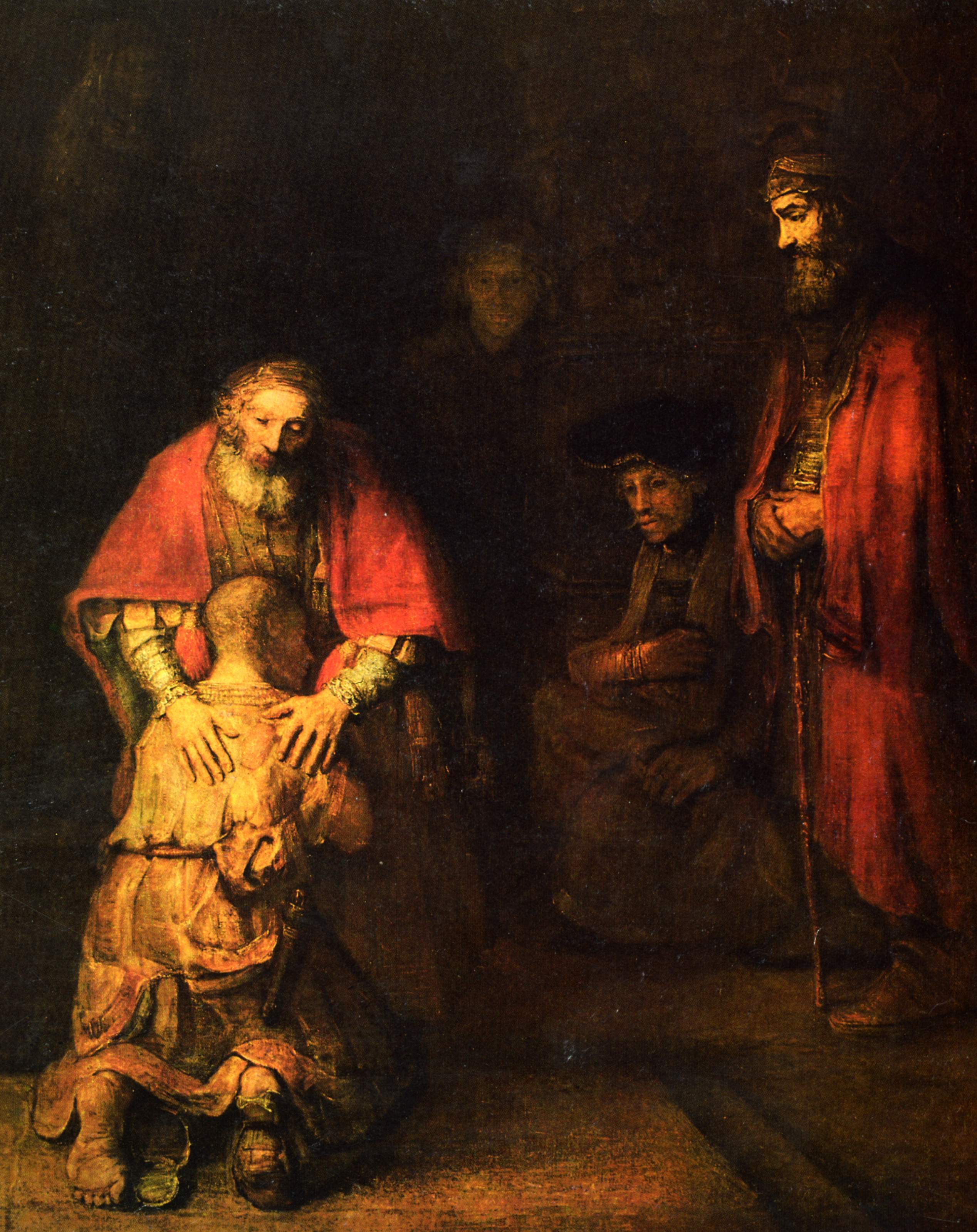
Several years ago, I read Henri Nouwen’s book, The Return of the Prodigal Son: A Story of Homecoming. It’s about his interaction with and reflection over Rembrandt’s painting, “The Return of the Prodigal Son.” It changed the way I saw my relationship with God, and it changed the way I see my ministry to others.

aparableprodigalson

Rembrandt’s painting refers to today’s scripture, “The Parable of the Prodigal Son,” found in Luke 15:11-32. It’s a reflection that has dramatically changed how I see our journey in faith, not to or through (both of which can be ‘completed’), but as a current and ongoing movement with God.

Let’s consider the Scripture again (the Message version):

“There was a man who had two sons. The younger one said to his father, ‘Father, give me my share of the estate.’ So he divided his property between them.

“Not long after that, the younger son got together all he had, set off for a distant country and there squandered his wealth in wild living. After he had spent everything, there was a severe famine in that whole country, and he began to be in need. So he went and hired himself out to a citizen of that country, who sent him to his fields to feed pigs. He longed to fill his stomach with the pods that the pigs were eating, but no one gave him anything.

“When he came to his senses, he said, ‘How many of my father’s hired servants have food to spare, and here I am starving to death! I will set out and go back to my father and say to him: Father, I have sinned against heaven and against you. I am no longer worthy to be called your son; make me like one of your hired servants.’ So he got up and went to his father.

“But while he was still a long way off, his father saw him and was filled with compassion for him; he ran to his son, threw his arms around him and kissed him.

“The son said to him, ‘Father, I have sinned against heaven and against you. I am no longer worthy to be called your son.’

“But the father said to his servants, ‘Quick! Bring the best robe and put it on him. Put a ring on his finger and sandals on his feet. Bring the fattened calf and kill it. Let’s have a feast and celebrate. For this son of mine was dead and is alive again; he was lost and is found.’ So they began to celebrate.

“Meanwhile, the older son was in the field. When he came near the house, he heard music and dancing. So he called one of the servants and asked him what was going on. ‘Your brother has come,’ he replied, ‘and your father has killed the fattened calf because he has him back safe and sound.’

“The older brother became angry and refused to go in. So his father went out and pleaded with him. But he answered his father, ‘Look! All these years I’ve been slaving for you and never disobeyed your orders. Yet you never gave me even a young goat so I could celebrate with my friends. But when this son of yours who has squandered your property with prostitutes comes home, you kill the fattened calf for him!’

“‘My son,’ the father said, ‘you are always with me, and everything I have is yours. 32 But we had to celebrate and be glad, because this brother of yours was dead and is alive again; he was lost and is found.'”

Who do you relate to in the story? Who do you empathize with and understand? Who seems ridiculously over-the-top or scandalously unwieldy? Who do we judge as ridiculously out of order? Who seems better than we could ever be? Who makes you angry?

Nouwen wrote that at different times in our journey of faith, we might actually be one or all of the figures depicted in the parable and its painting.  Consider with me the way that these roles play out in the story– and in our lives.

The Father. I can hardly imagine the grief the father felt when his son showed up and demanded his inheritance immediately. “I wish you were dead,” is the equivalent of the request. But the father graciously allows his son to have the money, and to leave. There are no arguments, no recriminations, no discussions about the foolishness of the decision. He just gives his younger son the money and lets him go.

Jesus’ hearers would’ve been offended, livid even, over the brashness of this culturally-naive and socially-destructive son. The fact that he blows all of his inheritance would’ve been received with 1st century comments about ‘karma’ and ‘getting what he deserved.’ But that’s not how the father sees it.

No, when the son finally does return, the father sees him while he is ‘a long way off’ and goes running to meet him. Now, you may or may not run to your children or grandchildren, but in these times, it would’ve been socially unacceptable for a grown man to run to his son. He would have had to hike up his robe, holding it to him, and run with difficulty toward his son.

The father, when the son arrives from the far country, is both actively looking for his long-lost son even though there is no guarantee that he will actually return, and willing to risk it all from a social status perspective to welcome his son home. He doesn’t care how it looks; he’s overjoyed.

This is the figure from the painting who we most often see as God the Father. (It helps in a paternalistic understanding of God where they’re both named “Father”.) But the thing is, we understand that sin causes us to reverse-disown God, and still, God at the first possible opportunity, is always finding a way to let us back in the house, via Jesus.

The Son. What do we make of this kid? He’s cocky enough to demand half of his father’s estate while his father is still alive. He doesn’t care about respect or values or family; he only wants what is his right then, right away. The immediate pleasure of an excessive bank account, eating and drinking whatever he wants, and being the big-time spender all drive his desire to cut ties with his family and be his own person. But he has no understanding about how much he depends on his family, or how money works.

It’s not long before he’s spent it all, and discovered that all of those relationships he thought he had were based solely on his bank account. He finds that when the money is gone, so is his security and his community. He desperately seeks some form of employment, but he’s an alien in the country where he went to party and the best job he can get is feeding pigs.

Now, not only are we talking about the embarrassment of low-income work for a white collar son of privilege, but we’re talking pigs. Pigs were unclean under Jewish law; the prodigal, as a Jew, shouldn’t even be touching them! His willingness to feed the pigs shows how desperate he is, and how far he’s fallen, not just in part with his father but with his faith heritage as well.

The younger son prays the sinner’s prayer of repentance. He admits his fault toward his father and to God, and then repeats that prayer when he returns to his father. The son doesn’t just repent verbally, but he literally travels a great distance home to make it right. Which one do you think was harder? Verbalizing his fault or actively going back to his father who he had shunned, scorned, and taunted with an early death?

We can probably remember some moments when we were like the son. Maybe they were several years ago, maybe they were last night. But we’ve all done something we’re not proud of; we’ve all had a moment where we recognized that our worldview wasn’t quite right, where we broke one (or several!) of the Ten Commandments. Maybe we thought we’d receive grace, maybe not. But the son is usually the easiest to relate to: messes up, repents, comes home, gets forgiven.

That’s basically it for the son though, isn’t it? He repents, returns home, makes amends, and is swept off of his feet by the graciousness of the father. He exits stage left.

The Older Brother. And that only leaves plenty of space for the older brother to announce his hurt feelings and anger over the injustice. See, the older son it says, has been working for his father without complaining in the fields. He’s basically been the father’s foreman, overseeing the servants and living a life between that of honored son and servant himself.

And he thinks he is doing all of that work so that he will reap the reward that is owed him. He expects that his father is going to save up everything that’s left since the younger son’s betrayal, and when he approaches the main house and hears the music and dancing, the frivolous nature of such a celebration is enough to infuriate him. He doesn’t even bother asking the father what is going on, but goes straight to one of the servants to ask what is going on.

It’s pretty apparent that the older brother’s tantrum was noticed by someone and reported to the father. But his father, who met the younger son halfway, comes out of the party to make time for the older brother. It’s not that he’s been ignored but his value is separate and different. The older son’s anger is partly because of what he feels like has been taken from his half because of the party, but it’s also because he has been letter-of-the-law obedient and the breaking of the law is an affront to his sensibilities.

The older son thinks he knows better than his own father! And because of his locked-in sensibilities about the law and way of doing things, he can’t acknowledge the joy of the celebration that is taking place.

I see the older son periodically in those of us who have been “churched” for a long time. We grow to expect that our view of church, sin, salvation, Jesus, God, style, worship, building usage, etc. is the way that God is most happy with. And then we miss out on all of the cool ways that other beautifully created and creative people see it, because God gave them that vision. And we keep matching all of their faith up against our faith and find that it’s different so we call it wrong. Not much fun being the older brother, is it? But we know if the father will forgive the younger brother then… he’ll also forgive the older one.

The Witnesses. There are several people in the shadowy background. One, at the top left, is understood to be a woman, potentially the mother of the two sons. We would expect her to be sympathetic to a son who returns, right? Maternal instincts and all. But in the context of the Jewish culture of the day, she had no standing to make decisions- it is entirely up to the father whether the wayward son is allowed to return (or not). Still, we assume that she had impacted the father’s thinking, making him even more sympathetic than he might have otherwise been.

Other male figures linger in the background. There is a seated man in a robe, understood to be a person of privilege, and there is a standing man, probably one of the servants. These two people don’t have a role to play in the actual parable but their “take” on what has happened is certainly curious.

Does the father’s rich friend begrudge the father his decision? Does he wonder why the father would re-embrace a son who has squandered half of his fortune? Is he wishing he could show the same grace to his own family? Does he worry that the father’s largesse has now damaged the way that their community, their society, will operate, if criminally negligent sons are given their own status back?

And how about the servant? Remember this: “‘All those farmhands working for my father sit down to three meals a day, and here I am starving to death… I don’t deserve to be called your son. Take me on as a hired hand'”? Does it give new meaning to what it means to serve the father? Does recognizing the perspective of one who has had the relationship, lost it, and wants it back change the way that this servant has for his role in relationship to the father?

The ramifications for what the parable has to say about us is significant.

-We have all wandered away, in our foolishness thinking that we could make it on our own, without God.

-God is always chasing us, eager to welcome us back. God is looking for us even when we’re still in the pigpen of our lives.

-Reconciliation happens when real repentance occurs.

-Obedience isn’t the end goal, but a heart of love for God and humanity is.

-It’s the community’s obligation to celebrate those moments, when sinners come home and real breakthroughs happen.

I pray today, that wherever you are on the continuum, that you would pray that God would make you right and restore you to the best you can be. God has granted us so much, shared so much love with us, not even holding back his own son. Repenting of our sins and sharing love with others is the least we can do.

‘The kingdom of heaven is like two children. One was obedient and one was not, but when the time came, the father sought both of them in love…’  Thanks be to God.

Posted in Current Events, Pop Culture, Sermons | Tagged , , , | Leave a comment

The Monuments Men: Does History Matter? (Movie Review)

The latest collaboration between George Clooney and Matt Damon plays out like a mashup of Indiana Jones (or National Treasure) with splashes of Ocean’s Eleven and Saving Private Ryan. Robert M. Edsel’s The Monuments Men: Allied Heroes, Nazi Thieves and the Greatest Treasure Hunt in History gets the big screen treatment, thanks to a screenplay and direction by Clooney, who serves as the glue in this epic tale of a ragtag band of scholars-turned-soldiers who steal back Europe’s art treasures from the Nazis.

Monuments Men plays like an older movie, like the films I watched as a kid about World War II starring John Wayne (he gets a shout-out here, too!) or the unconventional soldiers like The Dirty Dozen. Clooney’s art professor-turned-lieutenant, Frank Stokes, rallies a group of friends and art experts (Matt Damon, Bill Murray, Bob Balaban, John Goodman) to go over and save Europe’s most famous sculptures and paintings from the Nazis, who either want to collect it for themselves or destroy it so that no one else can have it.

Stokes also calls out of disgraced isolation the British officer, Lt. Donald Jeffries (Hugh Bonneville), who ends up being the first casualty of his Monuments Men. There are several questions raised like, is a work of art worth a man’s life? But the truth is that the movie signifies our need to reflect on our history and what we’ve created, to keep culture alive. Unfortunately, there’s an inclination here to have several “mini-movies” within the movie, and the editing and flow is clunky and jumps around given the way that Stokes’ team is broken up and sent around Europe to look for different items.

Jeffries’ story is one of the most compelling. He’s lost everything thanks to his addiction: his family, his military status, his father’s respect. But Stokes sees something in him that brings him back, that gives him hope and a purpose. And at one point, at Jeffries’ insistence, Stokes even admits that pity (or compassion) has made him reach out this way. It’s a second chance story, about finding purpose, and it gets tied into what it means to die with honor…. as we recognize that dying with honor still requires dying with purpose.

Often humorous, and sometimes devastatingly on historical point (the bin full of gold teeth still lingers in my mind), Monuments Men plays like a lark, but it still includes enough realism of what happened in World War II that we’d be foolish not to learn from it. Is it a great movie? No. But it still allows us to consider the choices we make, the things we take for granted, and the way that a bunch of ordinary men became heroes in protecting what society’s best was, in the face of brutal destruction. [I would be remiss in pointing out that Cate Blanchett’s Simone may be the most heroic of them all.]

Ultimately, I’m left wondering how often we make little decisions that are just as devastating. What does it look like when we individually or corporally decide that we will keep all the good stuff for ourselves, or worse, that if we can’t have it, we will destroy it so that no one else can have it either? That’s sick! And yet, it’s not limited to the behavior or inclination of the Nazis. Humanity still struggles with behaviors inclined that way, and we will until we can recognize that this life isn’t just about us.

Posted in Movie Reviews, Reviews, Theology | Tagged , , , , , , , , , , | Leave a comment

Gravity: Where Do You Get Your Strength? (Movie Review)

Castaway in space. That’s how my review was shaping up as I sat through the first two-thirds of the Oscar-nominated Gravity. Sure, Sandra Bullock was pulling off her typical ‘wow’ performance as Dr. Ryan Stone, first-time astronaut and survivor of a catastrophic space event that severed her connection with Earth and sent her reeling, untethered, into space. And there was George Clooney as veteran astronaut and team commander Lieutenant Matt Kowalski, soothing Stone as she tried to get back into a ’safe’ position back at the space shuttle. All of this was playing out about how I expected it to, and while, yes, it looked good, it wasn’t moving me.

And then the final third happened, and Alfonso Cuaron’s story, directed and moved about just as he wanted, hooked me. It’s fair to say that when you work your way through the close-to-three hours of special features, that no matter what your level of love for the movie is, that it will grow. How’d they make “Zero G”? What’s what the lights and the shadows? Was it hard playing Ryan? What gave Cuaron and his son Jonas the idea for this terrifically moving story?

For me, it’s always about the story. Sure, I wasn’t blown away by it (except visually, because, face it, even a blind person could “see” the way that the collisions happened and the inevitability of space thanks to Steven Price’s score) initially, but looking back, several hours later, I’m in awe.

What would it look like if you were the sole survivor? This isn’t the first movie to ask the question, but the depth and width and endlessness of space (in time as we know it) makes this a ridiculously different kind of movie. How would you cope? Now, that’s the more interesting question. And Kowalski’s involvement (I guessed how that worked, early on) shows a different side of how we cope with stress, survival, and isolation. But the thing is, we don’t have to go to space to find our lives flying out of control. We can face losing it all without going to space, and try to figure out what’s important and what has to be held onto. What would you lean on? That’s the question to end all questions, I think.

*SPOILERS BELOW

This is the second film (Children of Men being the first) where I have to scratch my head at the Catholic/faith sentimentalities of Cuaron’s mind. Again, a child plays a major role as “savior,” but here, it’s saving to and saving from. Ryan has been incapacitated by her daughter’s accidental and unnecessary death to the point where she just drives to work, and home, and work, and home. Now, she must find the strength to move forward, to get to safety, to return to Earth, to get unstuck. But in the process, she is both blessed by her daughter’s memory and freed from the anguish of her daughter’s death. Gravity proves to be about the grief process as much as anything else!

But one other thing struck me, in a strange parallel to the tractor scene in Walk the Line: it seems no accident that Ryan’s safety pod not only lands in the water but also sinks to the bottom, where she is forced to strip off her space suit. Her old pattern, her present situation, threaten to drown her if she doesn’t leave it behind, and she rises, liberated- baptized- changed forever. She sinks in the mud (a new Eve rising from the murk?) and takes her first, slow, gravity-influenced steps again, a new woman with a new life.

I’m still not sure I like Gravity more than 12 Years A Slave as a movie, but Bullock ran away with the Best Actress award in my mind. Her soulfulness, her determination, her raw emotion stick with me hours later, and I’m convinced that each of us, when faced with those kinds of moments, would experience the same.

Posted in Movie Reviews, Pop Culture, Reviews | Tagged , , , , , , , , , , , , | Leave a comment

True Detective Eps. 5-6: Descent Into Darkness (TV Review)

The fifth and sixth episodes of HBO’s True Detective are dark. Granted, the whole series is dark, so it’s almost as if showrunner Nic Pizzolatto is redefining what darkness looks like. Sure, we’ve already taken the dark to the level of a more graphic Criminal Minds but the shocking thing, at least by episode six, is the darkness we see inside the minds of ordinary people. Rather than spend the two episodes re-upping the slasher genre, Pizzolatto takes us inside the darkness inside of our own minds.

I’ll admit that Woody Harrelson and Matthew McConaughey have a way of bringing humor and irony, even in really tense situations. When they raid the farm in “The Secret Lives of Fate,” we have what happens juxtaposed to the way they wrote up the report. At this point, we know they still make it because we know 2012 is the present. But we recognize that the narration isn’t always trustworthy because they aren’t always trustworthy… and because we don’t know exactly what’s going on in their heads.

But if “The Secret Lives of Fate” feels like it’s an emotional payoff we’ve been waiting for, then “Haunted Houses” shows us that we haven’t gotten to the bottom of the barrel yet. On one hand, we have McConaughey’s Detective Rust Cohle exploring what he believes is behind the murders, through an association of private Christian schools, and on the other, the wavering commitment of Harrelson’s Detective Marty Hart to marriage and sobriety. Both men are going to go chasing after a demon, and both of them aren’t ready for what they’ll catch.

Out of respect for the preview I’ve gotten, I don’t want to spoil what actually happens, but wow. For viewers who’ve thought Michelle Monaghan was underused: your wait is over. “Haunted Houses” is an explosive, cliffhanger of an episode that makes me happy I already have my hands on episode seven. Another note I’d previously under appreciated is T Bone Burnett’s score. Maybe it’s because of the ordinary creepiness of this sixth episode, but the score’s mood connects us emotionally to the macabre violence Cohle and Hart have been dangerously close to. Too close.

Hart and Cohle do a regular dance around what’s real, where religion falls into all of this. But while religion gets pushed into the front of what threatens the world these two men “protect,” it’s clear that they fall into the “if you don’t stand for something, you’ll fall for anything” category. Their unraveling lives are the result of their frustration with their lives, their struggle with their own lack of grounding, and the vision of the world that they see every day. It’s a dark world, and they’re threatening to get lost in it.

Posted in Reviews, TV | Tagged , , , , | Leave a comment

Sunday’s Sermon Today: Are You Convinced? (Luke 16:19-31)

Imagine the most luxurious house you’ve ever seen. Was it in a movie? Was it watching Cribs or The Lifestyles of the Rich & Famous? It’s the kind of house that screams excess, that has more rooms than you could visit on a weekend tour, that has everything from the latest technologies to the most exquisite creature comforts.

That’s the kind of house that the rich man in our parable owned. He wore the most up-to-date fashions, even though he had no one to impress. He ate the finest foods, had the most capable servants, and threw away enough of everything left over to care for a small city.

Someone must’ve known that the rich man had more than he needed because one day, a beggar is placed on the rich man’s front stoop. So, here’s the poor man, Lazarus, which can be kind of confusing because he’s a ‘fictional’ character in one of Jesus’ parables, not the guy Jesus will raise from the dead. He’s covered with sores and starving

But he’s also in a position where he relies on the help of others: he is laid on the unnamed rich man’s step. He doesn’t walk there and collapse, but rather, some well-meaning people carry him to the rich man’s house and leave him there.

The expectation is that the rich man has so much that the rich man would have to care for the beggar Lazarus.  But there’s no conclusion to this story that makes us think that Lazarus actually received the crumbs, the scraps, or leftovers. This implies the malice of the rich man, that he would not even grant Lazarus that.

And the dogs came and licked Lazarus’ sores. You can interpret that one of two ways. Either even the dogs felt sorry for Lazarus or the rich man’s heart was so black that he didn’t even provide Lazarus protection from the dogs roaming the streets. That is the final nail it seems in the depths of the rich man’s soul: he denies the obligation or rule of hospitality that the Middle Eastern peoples would’ve known was expected.

This rich man was a class A jerk!

But Lazarus is put out of his misery (spellcheck made that “ministry” at first- I guess that could’ve been funnier!) and it says that the angels carried him to the side of Abraham.

The angels carried him to heaven: Lazarus went from persona non grata to priority number one. He went from ignored, left out, hungry, and in need, to the place of prosperity and honor next to Israel’s founding father, Abraham. There’s no detail to the parable, but Lazarus is “taken care of,” and much better than if he had been a made man.

“And the rich man died and was buried.” That’s all of the epitaph he gets because from the perspective of the parable, he doesn’t deserve more. He got everything he wanted on this side, so he’d maxed out on life. But in Hades, he’s missing something and he knows it.

The parable says that the rich man sees Lazarus and Abraham and asks for just a fingertip worth of water to cool his tongue. A fingertip’s worth of pity.

Rejection. That’s what Lazarus received/felt on earth, and it’s what Abraham sends back to the rich man across the divide.

Abraham says, “You had it all in life, while Lazarus had nothing, but now the roles are reversed. And there is a space that can’t be crossed between us.”

Maybe, just maybe, the rich man gets that he had his chance and missed it. So he switches angles, and asks that Abraham would send Lazarus to the rich man’s family so that they would change their ways. He wants Lazarus to give them the whole Jacob Marley treatment, so that they won’t end up there in Hades with him.  But he’s still not treating Lazarus like he’s his equal: he’s only directing the comments to Abraham to send Lazarus to deliver the message.

Abraham again rebuffs him: “your brothers have the writings of the Torah and the prophets to guide them.”

The rich man is growing desperate. “But a dead man would convince them and they will repent.”

Jesus via this fictional Abraham tells the rich man: “if they don’t repent because of the scriptures, they won’t be convinced by someone rising from the dead.”

Do you see the irony there? Do you get that Jesus-who-will-rise-from-the-dead says that wouldn’t be the only reason someone would believe… and yet it can be. What convinces each of us can vary from the intellectual to the heartfelt to the experiential. But Jesus here says it’s not enough just to see miracles: obedience is important, too.

I wonder what it would take for us to be really convinced. I mean, it’s understood, that we all believe to some extent, right? You’re reading this or sitting here, you must see some point to this, right?

But are we convinced enough to change? Did any of us really think of ourselves as the rich man in the parable? Or did we all assume that we were the righteous, suffering beggar?

I wonder, if we’re not guilty of living in excess and failing to see those who suffer around us. Is it someone in our family, our neighborhood, or work community? Do we need to recognize that God has given us the scripture, like the Ten Commandments, to guide our steps and help us to be who we’re supposed to be?

I think, if we’re willing to let God shine a light into our lives, that we need to recognize that we’re called to live differently than the world expects. That the best and the most aren’t always the most fulfilling; that caring for our neighbor means something in this life and the next.

Are you convinced by the life and love of Jesus? Have you let yourself be changed by God’s grace? I pray you have.

Someone has to carry the poor to the place where they can be cared for.

Someone has to recognize the suffering and work to heal them.

Someone has to admit that in doing so, we may have seen Jesus without knowing it.

For Jesus said,

“I was hungry and you fed me,
I was thirsty and you gave me a drink,
I was homeless and you gave me a room,
I was shivering and you gave me clothes,
I was sick and you stopped to visit,
I was in prison and you came to me.'”

“‘Then those ‘sheep’ are going to say, ‘Master, what are you talking about? When did we ever see you hungry and feed you, thirsty and give you a drink? And when did we ever see you sick or in prison and come to you?’ Then the King will say, ‘I’m telling the solemn truth: Whenever you did one of these things to someone overlooked or ignored, that was me—you did it to me.'”

May we entertain angels unaware, and recognize that our conviction is only present in how we live.

Posted in Current Events, Pop Culture, Sermons, Theology | Tagged , , , , | Leave a comment